“Your Honor, if you let my father go home, I can heal your legs” — The moment a little girl changed an entire courtroom forever.
The courtroom has always been a place of control — strict, structured, unemotional, where facts took precedence over feelings.
For over twenty-five years, Judge Eleanor Whitmore had defended this principle without exception.
Then came a case that initially seemed completely simple.
Daniel Carter, 36 years old, a warehouse worker with no prior convictions, was charged with stealing prescription drugs.
The evidence seemed clear.
The prosecution portrayed the case as a threat to the integrity of the healthcare system.
By all usual standards, everything pointed to a clear conviction.
But as the trial progressed, something began to break the established order.
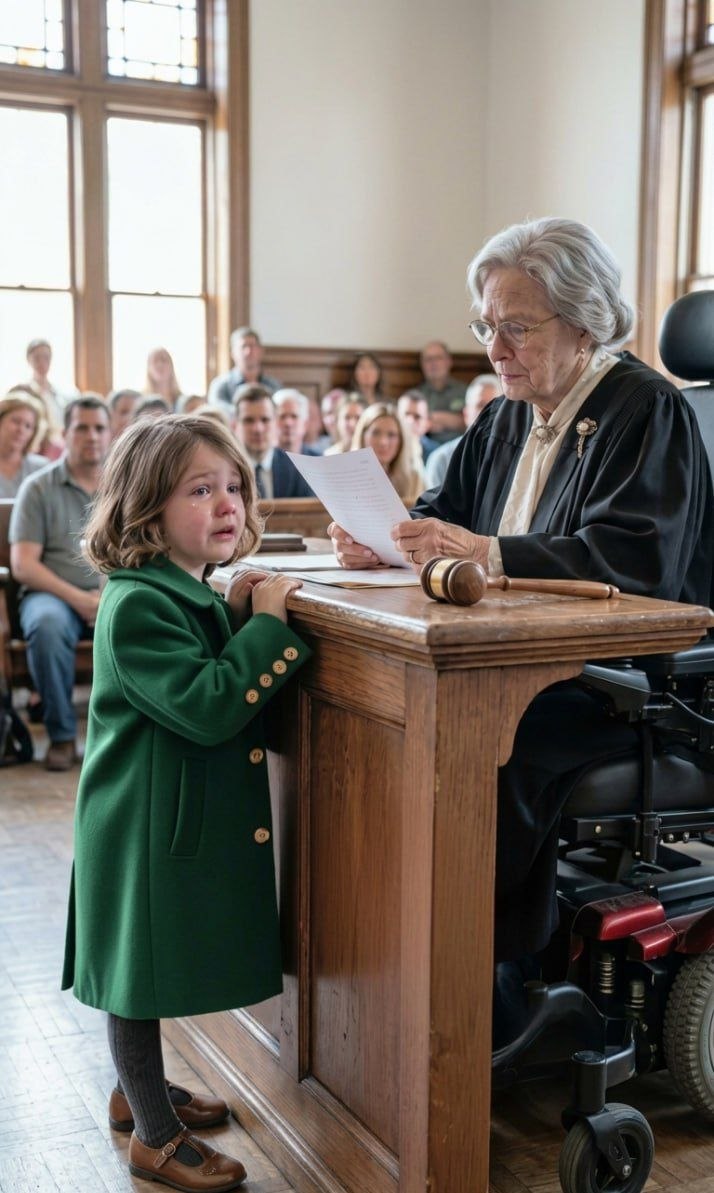
A little girl, barely six years old, stepped forward from the audience.
Thin coat, calm gaze.
She stopped in front of the judge’s bench and spoke softly, but with astonishing confidence:
“Your Honor… if you let my father home, I can heal your legs.”
The entire room fell silent.
Her name was Lily Carter.
When asked why her father had to go home, she simply replied:
He didn’t steal for bad reasons, but for her.
She could barely breathe without medication.
Her mother had died the previous year.
Her father worked nights, but the money was no longer enough.
 A Homeless Woman Accepted Food From a Little Girl — Then One Sentence Changed Everything
Daniel collapsed at the defense table.
“I told her I would take care of it,” he said.
“I didn’t know what else to do.”
What initially appeared to be a clear case of theft suddenly turned out to be something completely different — pure desperation.
I adjourned the hearing and questioned both sides again.
No prior convictions.
No indication of resale.
No evidence beyond personal use.
The act remained illegal, but the underlying motive was different.
As the meeting continued, a tense silence filled the room.
“Mr. Carter,” I said, “this court does not condone theft.
But justice requires context.”
I concluded that his act was motivated by an acute medical emergency and not by criminal intent.
Instead of a prison sentence, I ordered conditional release, probation under supervision, restitution, and full cooperation with the district’s social services.
In addition, I arranged for immediate medical assistance for his daughter.
A wave of relief swept through the room.
Daniel wept.
Lily simply smiled—calmly, confidently, without doubt.
As she was being led away, she turned around to look at me one last time.
“I can still heal your legs,” she said.
I had no answer.
The law didn’t change that day.
But something much quieter changed: the realization that behind every case there is a human story, and sometimes the smallest voice carries the greatest truth.
I understood once again that compassion is just as important as the rigor of the law.