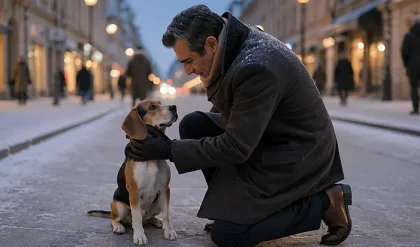
The city around him continued to pulse as if he weren’t there.
Shoes whizzed by, a bus rumbled in the distance, traffic hummed softly under the trees.
But on the pale stone ledge in front of the old building, it all seemed distant and unreal to the man in the wrinkled gray suit.
He rested his elbow on his knee.
One hand covered his face, the other hung limply beside him.
A red mark burned across his face.
It was fresh.
He had been trying to hold back a public meltdown for an hour.
He hadn’t succeeded.
Important moment: sometimes a single gesture from a stranger is enough to break the toughest silence.
Then a small shadow stopped in front of him.
The man suddenly looked up.
A barefoot little girl stood there, her torn brown linen dress hanging dustily on her.
Her hair was disheveled, her knees were covered in dirt, and she held out her palm to him.
A piece of broken bread rested in her hand.
It wasn’t much.
Barely enough for a hungry child.
Yet there was a surprisingly strong, wet, and caring light in her eyes.
“Are you hungry too?” he asked.
The man blinked.
He didn’t answer for a while.
He just looked at the bread, then at the child’s bare feet on the dirty sidewalk.
The bread was dry and rough, obviously not fresh, yet it was clearly a prized possession.
Probably the only one he had.
He slowly lowered his hand from his face.
“No…” he said, trying to smile despite the pain.
“I’m not hungry.”
The girl didn’t move.
She continued to hold her arm out towards him.
“You can still eat a little of it.”
That made it worse.
Much worse.
The man caught her gaze for half a second and swallowed.
He tried to compose himself, but tears were already burning behind his eyes.
He was supposed to be a grown man.
A lawyer.
A husband.
A breadwinner.
Instead, he had just stepped out of the family office after signing the final piece of his life.
His brother called him weak.
His wife told him not to go home until he “pushed himself together.” When he tried to respond, his brother punched him in the face in front of everyone.
Not because of the business.
Not really.
But because in this family, men were not allowed to get married.
The girl took a small step closer.
Her voice became even gentler.
— Please.
The man looked at her again.
There was no pity in it.
Just simple, pure concern.
Innocent attention.
And that innocent concern hit him harder than any rudeness.
She looked at the bread again.
Then at the little fingers that held it.
At the hem of the torn dress.
At her face.
A trembling sigh escaped her.
“Why would you give me your bread?” he asked.
The girl frowned, as if the answer was obvious.
“Because you look sad.”
When the world turns its back on someone, it’s often a child who is the first to realize they need help.
Behind them, the city seemed to blur.
Something changed in the man’s face.
The smallest, most broken laugh in the world broke out.
She studied him as seriously as if he were a man much older than her.
Then he asked in a barely audible voice, over the roar of nearby traffic:
“Then why are you crying?”
The question hit him like the opening of an old wound.
The man wanted to answer.
Nothing came out of his throat.
His tongue was clenched, his eyes were stung by tears, his hands were shaking.
Finally he just said this:
“I think… I’ve lost everything.”
The little girl froze.
Then, without asking, she carefully broke the piece of bread in two and pressed one half into the man’s hand.
Their fingers touched.
At that moment, the man froze.
Because something impossibly familiar ran through him.
Not the girl’s hand.
But the gesture.
The tenderness.
The precise way they broke the bread.
A memory ripped through him with such force that it almost took his breath away.
A rainy afternoon many years ago.
A young woman on the other side.
Dark hair.
Tired eyes.
She laughed quietly as she broke a piece of bread in two and handed it to him.
“You look hungry,” he told her then.
Not with sympathy.
With love.
Her name was Elena .
And she had disappeared from his life seven years earlier.
Before he could reach her.
Before he could fix what his family had ruined.
Before he even knew if the baby she was carrying had survived the beginning.
The man’s fingers clenched around the bread.
He looked at the little girl as if the world had suddenly tilted sideways.
The same quiet kindness.
The same gaze.
Even the stubborn lifting of his chin was the same when he was afraid.
His voice came out hoarsely:
— What… what did your mother call you?
The girl was about to answer.
She blinked.
Then she spoke very quietly:
“Mom says I’m Rose.”
The man’s breath caught.
Rose.
She and Elena spent an entire evening in a small apartment, lovingly arguing over possible baby names.
If it was a girl, Elena wanted the name Rose.
“She’ll be small,” she said then, smiling, “but strong.”
The man’s fingers began to tremble around the bread.
He leaned forward, both terrified by the answer and unable to stop asking.
— Rose… and what else?
The girl hesitated.
— Rose Elena.
At that moment, everything stopped in him.
The traffic seemed to slow down.
The footsteps.
The city.
Everything around him disappeared.
He looked at it as if he were seeing a ghost of light and dust.
His lips parted, but no sound came out.
The girl slowly lowered her hand.
Her gaze immediately sought his face.
“Mom said,” he whispered, “that if I ever met a man who cried like he’d lost someone and looked at me like that, I should tell him my full name.”
He couldn’t breathe.
Rose swallowed another sentence, then said the full name:
— Rose Elena Carter.
Note: sometimes a name not only identifies, but also gives back something that was taken away years earlier.
Carter.
His last name.
Not the shiny, courtroom version.
Not the polished family label.
The real one.
The name Elena loved before money poisoned everything.
The man’s eyes immediately filled with tears.
“Where is your mother?” he asked, almost choking on his own words.
Rose turned to the other side and pointed down the street.
Near the side entrance to the church shelter sat a woman, wrapped in a faded coat.
Her head was bowed, one hand resting on her chest.
She knew who it was from afar.
He knew the curve of her face.
The slump of her shoulders.
The way she bore the pain silently.
— Elena…
The name burst out of him before he could hold it back.
The woman looked up.
She remained motionless for a moment.
Then her face changed completely.
First, shock.
Then fear.
Then something deeper, something she hadn’t dared hope for in years.
The man stood up too quickly, almost tripping as he stepped off the stone ledge.
“Rose,” he said, kneeling before the little girl.
“Stay here for a moment, okay?”
However, Rose shook her head and took his hand.
“No,” he said quietly.
“Mom doesn’t like me going over there alone.”
This almost broke him completely.
So he squeezed the little hand.
And they crossed the road together.
Elena was already standing when they arrived, though she looked weak and unsteady.
For long seconds neither of them spoke.
His gaze traveled over her face, as if to absorb the wasted years.
The fatigue.
The thinness.
The pain.
Yet, somehow, she was still there.
“Elena…” he said again, his voice broken.
“You’re alive.”
The woman’s eyes filled with tears.
“I tried to tell you,” he whispered.
“Your brother found me before I could get to you.
He said you were married.
He said you didn’t want to know about us.”
The red palm print on his face instantly faded into insignificance.
His face fell apart.
— He lied.
“I know now,” Elena said, tears falling freely.
“But by the time I realized it… Rose was already born.
And I had nothing.
I didn’t want your family to take her away from me.”
The man immediately knelt there on the sidewalk.
Not out of weakness.
Out of pain.
Out of relief.
He collapsed from the weight of the realization that he finally saw what had been stolen from him.
His gaze rose to Rose.
The little girl watched them with calm seriousness, still holding the smaller piece of bread in her hand.
“He said you were sad,” Rose murmured, looking at her mother.
“So I gave him some.”
Elena put her hand over her mouth and started to cry.
The man looked at the girl once more, then a broken voice, half laughing, half sobbing, burst out of him.
“You gave me your only bread.”
Rose shrugged, as if kindness were the easiest thing in the world.
“You seemed to need it.”
At that moment, everything in him broke.
She raised her arm, slowly and hesitantly.
Rose looked at her mother.
Elena nodded, her face tearful.
And the little girl stepped into her embrace.
It felt like he had been searching for this moment in every room his whole life and never thought he would ever find it.
His daughter.
Finally.
Rose rested her face on his shoulder and whispered in a small, tired, yet firm voice:
“See? I told you you were hungry too.”
The man closed his eyes.
His tears fell unstoppably.
Not because of bread.
But because of love.
Because of home.
Because of the lost years that came between them.
There, on the city sidewalk, holding his rejected child and looking at the woman he could never let go of, he suddenly understood something.
He didn’t lose everything.
He had found what was most important.
Elena knelt down before them with difficulty.
He let go of Rose enough to look at the woman.
“Tell me what you need,” he said.
Elena lowered her head.
“I didn’t come looking for you.”
— I know.
“I didn’t mean to show up like this.”
— Elena…
“I didn’t want you to see it like that.”
He shook his head.
“You’re not broken.”
He laughed bitterly.
“I live in a shelter.
My daughter walks barefoot.
I’ve been sick for two weeks and haven’t been able to go to the doctor.
If that’s not heartbreak, I don’t know what is.”
Guilt spread painfully in the man’s chest.
“Are you sick?”
Elena looked away.
“It’s just an infection.
It’ll go away.”
Rose clung tightly to her newly found father.
— Mom coughs at night.
Elena closed her eyes.
— Rose…
“And sometimes he doesn’t eat so I can.”
The silence that followed was more painful than any scream.
The man looked at Elena.
“We’re going to the hospital.”
Elena stepped back.
— No.
— Elena.
“I can’t owe your family anything.”
He took a deep breath.
“It’s not my family talking to you.
It’s me.”
The woman looked back at him with a mixture of anger and fear.
“You were one of them.”
The sentence was true.
That’s why he hit it hard.
He lowered his head.
— Again.
Elena pursed her lips.
“They left me alone.”
— I know.
“They made me believe you despised us.”
— I know.
“And when I tried to look for you, every door was closed to me.”
He looked up.
“Then I’ll open them all today.”
Elena didn’t answer.
He stood up slowly and took out his phone.
His hand was still shaking, but his voice was no longer broken when he spoke.
It had become cold.
Calm.
Dangerously precise.
— Samuel.
His assistant on the other end of the line answered immediately.
— Carter watch.
“Send a car to St.
Matthew’s Church.
Immediately.
And call the private hospital.
I need a room prepared for Elena Morales, and a full examination of a seven-year-old girl, Rose Elena Carter.”
Elena froze at the family name.
Rose looked up curiously.
“Is that my last name?”
The man leaned down to her.
Her eyes filled with tears again.
“Yes, honey.
If you want, you can.”
Rose thought about this surprisingly seriously.
“Mom said Carter was a sad name.”
He looked at Elena.
The woman did not look away.
“That was true,” he admitted.
“But it could be otherwise.”
Elena swallowed her tears.
“Don’t promise something you can’t keep.”
 The girl stood barefoot in the snow and waited for her mother until bikers appeared on the road.
He looked back at her.
“I’m not making any comfortable promises right now.
This time I’m going to show you.”
The car arrived ten minutes later.
It wasn’t a flashy luxury car, but a subdued black minivan.
Still, Elena hesitated before getting in.
Rose stared wide-eyed at the leather seaTS.
“Can I sit here with muddy feet?”
The man felt something inside him break again.
He crouched down in front of her.
“You can sit here however you want.”
Rose looked at her mother, checking.
Elena swallowed hard and nodded.
At the hospital, doctors determined that Elena had a serious infection, was dehydrated, and was extremely exhausted.
Rose was underweight and had small cuts on her feet, but remained in stable condition.
When the doctor said this, the man had to step out into the hallway.
He didn’t want Rose to see him cry again.
But Elena saw him from the ward.
She saw him leaning against the wall, leaning forward, covering his face with both hands.
And for the first time in seven years, something else mixed into his anger.
Not forgiveness.
Not yet.
But there is the painful certainty that he couldn’t have known all this either.
That they took something from him too.
Not all losses are immediately visible.
Some are only recognized in a quiet moment years later.
Hours later, when Rose was already asleep on a small bed by the window, Elena spoke softly.
“Your brother said you got married.”
He turned towards her.
— Never.
“Yet the engagement was announced.”
“Before I signed anything, I closed it.”
— Why?
He looked at Rose’s sleeping face.
“Because I still loved you.”
Elena closed her eyes.
The answer hurt him.
Not because it was cruel.
But because it came too late.
“I waited for you,” he whispered.
“In the first few monThS. Even after Rose was born.
Every time someone walked through the door of the shelter, I thought it might be you.”
He slowly sat down in the chair next to the bed.
— I was looking for you.
Elena opened her eyes.
— Where?
“Everywhere they left me.
At the fake addresses my brother gave me.
At the hospitals my father claimed to have admitted me to.
Even at an unmarked grave that they led me to believe could have been yours.”
Elena put her hand over her mouth.
— No…
“They said you died during childbirth.”
The woman began to cry silently.
He leaned forward.
— Elena, I need to know everything.
Names.
Dates.
Who spoke to you.
Who threatened you.
Everything.
Elena looked at him wearily.
— For what?
His face changed.
He didn’t harden against her.
He hardened for her.
— Because today my brother didn’t just take a company from me.
He glanced at Rose.
“It also took away the seven years I spent with my daughter.”
By the next morning, the Carter family realized that the man they called weak was no longer asking for permission.
His name was Daniel Carter .
And though he had spent years trying to survive in a family where power was confused with right, that day something inside him changed forever.
Daniel didn’t return to the family home.
He didn’t call his wife.
He didn’t apologize.
He didn’t explain.
He did three things.
- He hired an independent lawyer for Elena.
- He ordered a private investigation into his brother, William Carter.
- He requested a DNA test.
Not because he doubted.
But because he knew that to defend Rose, the facts had to be confirmed against any attack.
The results arrived within forty-eight hours.
Paternity probability: 99.9999%.
Rose Elena Carter was his daughter.
Daniel held the paper without saying a word for a long moment.
Then he went into the room where Rose was drawing with pencils that a nurse had given her.
“What does it say?” the girl asked.
Daniel knelt down in front of him.
“That I am your father.”
Rose looked at the paper.
Then she looked up at him.
“Really?”
He nodded.
— Really.
The little girl looked down at her feet, now wrapped in clean socks.
“Then can I call you dad?”
Daniel closed his eyes.
“You call me whatever you want.”
Rose thought for a moment.
Then she raised her arm.
– What.
Daniel hugged her so quickly that he almost wanted to apologize for the sudden move.
But Rose laughed.
Small, clear, for the first time.
Elena watched them from the doorway, tears streaming down her face.
Daniel looked over his shoulder at her.
He didn’t say anything.
He didn’t have to.
The war began that afternoon.
William Carter arrived at the hospital with two lawyers, wearing the same smile he had used to break lives in the courtroom.
“Daniel,” he said, “this is shameful.”
Daniel stepped out into the hallway and closed the door so Rose wouldn’t hear anything.
“Don’t say his name.”
William sighed.
“Has that kid messed with your head yet? You’ve always been easily influenced.”
Daniel faced him.
— DNA confirmed that she is my daughter.
William’s smile faltered for the first time.
Only for a moment.
But Daniel noticed.
“You knew.”
William regained his composure.
“I don’t know what you’re talking about.”
Daniel took out a file.
— Elena’s messages.
Payments to guards.
Fake death reporTS. Made-up addresses.
And a reference to the name of the man who kicked her out of the building when Rose tried to meet me as a newborn.
William’s face hardened.
“You shouldn’t have investigated this.”
“You shouldn’t have done it.”
His brother stepped closer.
“I did everything to protect the family name.”
Daniel laughed dryly.
— No.
You did it to keep control over me.
William lowered his voice.
“That woman would have ruined me.”
“That woman loved me.”
“He was poor.”
“It was mine.”
The word carried not possession, but painful recognition.
William looked at him contemptuously.
“You’re still weak.”
Daniel touched the old red mark on his cheek.
— No.
I just don’t look like you anymore.
William’s lawyers tried to intervene, but Daniel ignored them.
— I’ll report you.
William remained motionless.
“You wouldn’t dare.”
Daniel opened the door to the ward a crack.
Inside was Rose sleeping.
Elena sat next to her.
One of the little girl’s hands was clutching her mother’s.
Daniel looked at his brother.
“I’ll do anything for them.”
The Carter family was rocked by the scandal for weeks.
The press wrote about fraud, threats, abuse of power, and document manipulation.
William tried to deny it, but too many people had kept evidence for years: secretaries, drivers, guards, and employees who had grown tired of the cruel orders.
Once Daniel was no longer afraid, others did not remain silent either.
His wife, who had told him not to go home until he sorted himself out, filed for divorce before he could.
Daniel didn’t fight it.
He signed it.
At first, signing a piece of paper didn’t feel like a loss.
It felt like a breath of fresh air.
Elena didn’t move in with him right away.
“I’m not going to trade a shelter for a villa overnight,” he said.
Daniel nodded.
— I understand.
“And I won’t pretend that seven years can disappear just because you know the truth now.”
“I don’t even ask.”
— Rose needs security, not guilt-wrapped gifTS.
Daniel lowered his head.
“Then teach me how to be present.”
Elena looked at him for a long time.
— Start by arriving exactly when you say you will.
And he really did.
It arrived.
Every day.
Exactly.
First to the hospital.
Then to the small apartment that Elena had accepted with legal assistance, not as a favor, but as part of the reparation.
Daniel brought food, but not too much.
He brought shoes for Rose, but let her choose the color.
He carried books.
He read stories.
He learned what she liked to eat.
He learned to be afraid of thunder.
He learned to hide bread under his pillow because he was afraid there wouldn’t be enough the next day.
When he first found her, Daniel sat on the hallway floor and cried silently.
Then he didn’t scold the girl.
He just took a small box and said:
“This will be our breadbasket.”
Rose frowned.
“How do we hide it?”
— To preserve it.
And every time it runs out, we refill it.
He looked at her searchingly.
“Always?”
— Always.
The box was never empty again.
Over time, Rose stopped hiding the food.
Elena began to gain weight back.
The cough disappeared.
Her face regained color.
But her confidence returned more slowly.
Daniel accepted this.
There were things that love could not demand.
It could only wait.
One afternoon, months later, Rose led Daniel to the same ledge where she had first found him.
The city moved on.
The shoes moved on.
The traffic rumbled softly under the trees.
The girl sat down next to him with a bag full of fresh bread.
“You cried here,” he said.
Daniel smiled sadly.
— Again.
“I thought you were hungry.”
— I was.
Rose looked at him in confusion.
“But you said no.”
Daniel broke a slice of bread in two.
He gave her half.
“I was hungry for you.”
Rose thought about this for a long time.
Then she snuggled into his arms.
“Then it’s a good thing there was bread.”
Daniel stroked his hair.
“Yes, my dear.
Very good.”
Elena watched them from a few steps behind.
Daniel looked up at her.
This time Elena didn’t look away.
She slowly walked over and sat on Rose’s other side.
For a while, the three of them ate bread in silence.
It wasn’t a perfect scene.
It didn’t erase the loss.
It didn’t give back the stolen years.
But it was real.
And that was it, after all the lies, it was enough to start living.
Years later, Rose barely remembered the hunger.
The brown clothes, the dirty feet, and the hard bread, only as fragments of an old life that her mother and father had tried to leave behind.
But Daniel never forgot it.
He kept the first piece of bread in a small glass box on his desk.
Not out of sadness.
Out of gratitude.
Because that dry, broken morsel, held out to him by the hand of a hungry little girl, had given him back his life.
When someone asked him why he created a meal program for homeless families, founded a legal foundation for mothers threatened by large families, or gave up part of the Carter empire to build something more humane, he always answered the same thing:
— Because a hungry little girl taught me that it’s okay to give even when there’s barely anything left.
And if anyone asked what he had lost that day in the family offices, he would smile.
The answer doesn’t hurt anymore.
He lost a company.
A fake last name.
A cold house.
The fear of being labeled weak.
But on a sidewalk, thanks to a piece of broken bread, he found Elena.
He found Rose.
He found his true home.
And he understood that the deepest hunger does not always reside in the stomach.
In the end, this is what remained: the certainty that what was once lost through love can be found again with a single sincere gesture.
And for Daniel, a child’s small, brave gesture proved to be the gateway through which he could re-enter life.