Émilie walked down this street every morning at eight o’clock.
She worked in a small bakery in the neighborhood, and her route had remained the same for three years.
She knew every crack in the sidewalk, knew which lamppost someone often slept in front of, knew where the old woman who fed the pigeons sat.
But that morning, everything was different.
From a distance, she heard the noise.
It wasn’t an ordinary bark.
It was a voice that seemed to tear itself apart, each fragment revealing something indescribable.
Emily slowed down.
She saw the dog circling in a street corner where no one usually sat.
There was a blanket, an old jacket, a bowl.
And suddenly, Emilie remembered.
That jacket.
That blanket.
Every morning, when she passed by, a man sat there.
He never asked for anything.
He simply stayed there, sometimes writing something in a small notebook, talking to the dog in a soft voice, almost a whisper.
The dog noticed that Emily had stopped.
He ran towards her for a few steps, then backed away, then came back again.
In his eyes, there was no longer just despair, but something sharper, deeper.
A need.
Emilie sat down quietly on the ground, not to approach the dog, but simply to get down to its level.
She looked at the blanket.
It was spread out carefully, not tossed about haphazardly.
The jacket was folded on top of it, and a small stone rested on the jacket to keep it from being blown away by the wind.
It was the kind of care one gives to someone they love.
The dog looked after these things as if they were a part of its owner.
“Did you lose it?” Emilie asked the dog, even though she knew it wouldn’t be able to answer.
Emilie decided to stay.
She took out her phone, called the bakery, and said she’d be there a little later.
Then she looked around.
Passersby were still stopping, looking, then moving on.
No one knew what to do.
But suddenly, Emilie remembered something.
A few days earlier, she had seen an ambulance on this street.
She hadn’t paid any attention to it at the time, but now the pieces of the puzzle were falling into place.
See more
history
Arts and Entertainment
dog
She started calling nearby hospitals.
The first two knew nothing.
At the third, a nurse remained silent for a long moment, then said, “Wait, I think there’s someone like that.
A man brought in a few days ago.
He has no papers, he doesn’t speak much, but he keeps murmuring something.”
Emilie asked if she could come.
The nurse said yes, but asked what she would do with the dog.
Emilie looked at the animal.
It was trembling all over, but its eyes now followed Emilie’s every move.
It knew.
It understood that something was changing.
Emilie decided to take the dog with her.
She knew she wouldn’t be able to take him to the hospital, but she also knew she couldn’t leave him there.
She approached slowly, extending her hand not to pet him, but simply to show that she posed no threat.
The dog looked at her hand for a few seconds, then approached, very slowly.
He did not allow himself to be petted, but he allowed Emilie to take the jacket.
“Come,” said Emilie, “I’ll take you to him.”
They set off.
Émilie in front, the dog behind, a few steps away, but following her every move.
Sometimes the dog would stop, look back toward the corner of the street, then hurry to catch up with Émilie.
As if he understood that he was leaving the only place he knew, but he also understood that if he didn’t leave, he would never find his master again.
In front of the hospital, Émilie stopped.
She knew they wouldn’t let the dog in.
But she also knew something she had learned over the years: there is always a way, if you really want to help.
She went in, found the nurse and told them everything.
The nurse was a woman in her fifties who had worked at the hospital for twenty years.
She had seen many things, but when Emily told her about the dog that called for its master day after day on a street corner, the nurse’s eyes moistened.

“Wait here,” she said, and disappeared down the corridor.
Ten minutes later, she returned with a young doctor.
The doctor explained that the man’s condition was stable, that he would be released in a few days, but that he kept talking about a dog, repeating its name over and over.
“He thinks his dog is left alone in the street, and that’s tormenting him more than his own illness.”
Emilie asked if she could bring the dog into the yard.
The doctor thought for a moment, then nodded.
He said he would arrange for the man to come down and sit on a bench for a few minutes.
And that’s what happened.
When the man was taken down in his wheelchair, he stared at the ground, tired and lost.
He didn’t understand why he had been brought out.
And then the dog saw him.
It was one of those moments when even the wind stops.
The dog didn’t bark.
He didn’t run.
He froze for a moment, as if he couldn’t believe his eyes.
Then, slowly, almost timidly, he began to approach.
The first steps were slow, then faster, then he was already running, but not bounding – he was running like someone who has traveled a long way and finally sees the finish line.
The man raised his head.
His eyes widened.
He stretched out his arms, and the dog was in his embrace as if it had always been there.
No noise.
No barking.
Only the dog’s head against the man’s chest, the man’s hands on the dog’s back, and a long, endless silence in which everything was contained.
Emilie stood further away.
The nurse was wiping her eyes.
Even the doctor, who had seen thousands of stories, remained motionless, watching.
The man whispered something in the dog’s ear.
The dog licked his cheek.
Then the man looked at Emily.
He didn’t know who this woman was, but he knew she was the one who had brought his friend back.
In her eyes were tears, but not sadness.
Something else.
Gratitude, hope, and a small smile.
A few days later, when the man was discharged from the hospital, he came to the small bakery where Émilie worked.
The dog was by his side, its eyes already peaceful, almost smiling.
The man stayed outside for a long time, then went in and bought two loaves of bread.
One for himself, one for the dog.
Emilie saw him through the window.
She went outside.
They stood on the sidewalk, the dog between them, its tail wagging gently.
“He’s my only family,” the man said softly.
“I was afraid he’d think I’d abandoned him.”
“He didn’t mean that,” said Emilie.
“He called you.
Every day.
So loudly that people stopped to listen.”
The man looked at the dog.
The dog looked back at him.
And in that look, there was something no words can describe.
Something people search for their whole lives, sometimes finding it, sometimes not.
Loyalty.
Love.
A home that isn’t a place, but someone with whom you feel safe.
Emilie offered to help them clean their street corner.
The three of them went.
The wind had blown away the stone that had been lying on the blanket, but the blanket was still there.
The dog ran ahead, sat down by the jacket, and watched them.
He seemed to be saying, “There, I’ve kept everything.
I’ve waited.
I knew you’d come back.”
From that day on, Émilie stopped every morning on her way.
Sometimes she brought a coffee, sometimes a piece of bread.
The dog always saw her first, ran towards her, tail wagging, then returned to his master, as if to say: “This person is good, I have chosen her.”
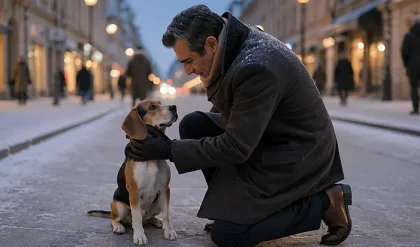
And one cold morning, when the whole street was covered in a transparent frost, the man and the dog were sitting in their usual spot, and the dog had rested its head on its master’s lap.
Emily approached and saw that they were both looking up at the sky, from where, suddenly, a ray of sunshine pierced the clouds.
The beam of light fell directly on them.
The dog closed its eyes.
The man smiled.
Émilie understood that at that street corner, between those three beings, at that precise moment, the most perfect thing in the world was happening.
Nothing grand, nothing glorious, nothing heroic.
Simply a man, a dog, and someone else who had decided to stop.
And that was more than enough.