She discovered them in the snow and decided it was a sign of fate. Four years later, the truth itself crossed the threshold of her home—in the guise of a billionaire.
The scream cut through the snowstorm like a sharp knife.
Not loud. Not desperate. So quiet that it might not have been heard by anyone who had already given up on the night.
Sandra Whitlow remembered that sound forever.

Later, when the residents of Rose Hill spoke of miracles, they imagined a soft glow, church bells, palms raised to the sky. But her miracle was different. It came in a fierce Colorado snowstorm, behind a small sewing shop with the scent of fabric and cedar, where the wind battered the walls as if it wanted to tear the world apart.
At twenty-four, Sandra lived alone above her workshop, Grace Thread—in cramped rooms with slanted ceilings and old pipes that groaned dully in winter. Her life was simple and quiet. She tailored wedding dresses for women who barely noticed her. She mended work jackets for men who forgot to pay on time. She created beauty for a city that rarely considered who created it.
But that night, when she was about to turn off the light, she heard it.
Scream.
Weak. Brittle. Alive.
A chill ran down her spine.
Sandra grabbed the flashlight and rushed to the back door. The wind hit her with such force that she barely managed to stay standing, clutching the doorframe. Snow swirled down the alley in thick eddies. For a second, she couldn’t see anything around her.
And then, by the woodpile, half-covered in snow, stood a wicker basket lined with dark purple velvet.
Something stirred inside.
Sandra dropped to her knees so abruptly that a chill seemed to penetrate her bones. She threw back the blanket—and her world changed.
Two newborn girls lay next to each other, cuddled together. Their small faces were flushed from the cold, their breathing barely perceptible but lively. They were wrapped in identical pink wool blankets, and around their necks hung thin silver pendants in the shape of falling leaves.
No note.
No names.
Just a torn photograph, damp at the edges: half of a woman’s smiling face—one eye, a cheek, and the curve of lips that once held joy.
Sandra’s hands were shaking so much that she could barely hold the lantern.
– No… no, no…
One of the babies stirred, her tiny fingers reaching out into the icy darkness and tightly gripping Sandra’s thumb.
The touch was almost weightless.
Helpless.
And at the same time – final.

It was as if something inside her had split. Not a thought. Not a decision. Something much deeper.
Connection.
“I’m with you,” she whispered, tears freezing on her eyelashes. “I’m close. I’m with both of you.”
She hugged them to her chest and rushed inside, wrapping her coat around them, as if the warmth could ward off death. Later, the doctor would say: just a little more, and they would have been beyond saving.
She named them Aria and Laila.
From that night on, her life no longer belonged to her alone.
The years flew by in a whirlwind of sleepless nights, hot foreheads, lullabies accompanied by the sound of a sewing machine and little boots at the door. Aria grew up dreamy—with serious eyes and a habit of sketching dresses on any scrap of paper. Layla was the complete opposite—bold, boisterous, always on the move, with endless questions:
— Why don’t stars fall?
— Do snowflakes ever get lonely?
— Did God forget to give us a dad, or was he just busy?
Sandra responded when she could. And simply hugged when words failed.
Money was always tight. Sometimes the workshop barely stayed afloat. Sandra learned to make bone broth, economize on electricity, and transform scraps of fabric into dresses so beautiful that the girls twirled in them as if poverty had no effect.
But every night, when the twins fell asleep, Sandra would take a tin box from under the bed.
Inside were two silver pendants and half a photograph.
She ran her finger over her smiling lips and wondered: who could abandon newborn children in a snowstorm? And why with jewelry that could feed a family for months?
This mystery hasn’t disappeared. It’s simply learned to exist alongside love.
Until that winter when everything changed.
The phone rang on Wednesday afternoon. Aria was drawing fairy wings on wrapping paper, and Lila was trying to make a jar of buttons “sing.”
The coordinator from Denver spoke quickly and excitedly. A problem had arisen at the city’s most exclusive charity event: three expensive dresses urgently needed alterations. The hired dressmaker had fallen ill. Someone in Rose Hill recommended Sandra.
“We’ll pay three times the usual amount,” the woman said. “Cash today.”
Sandra stared at the cracked wall as the numbers added up in her head: rent, coal, doctor, fabrics…
She agreed, not even giving caution a chance to intervene.
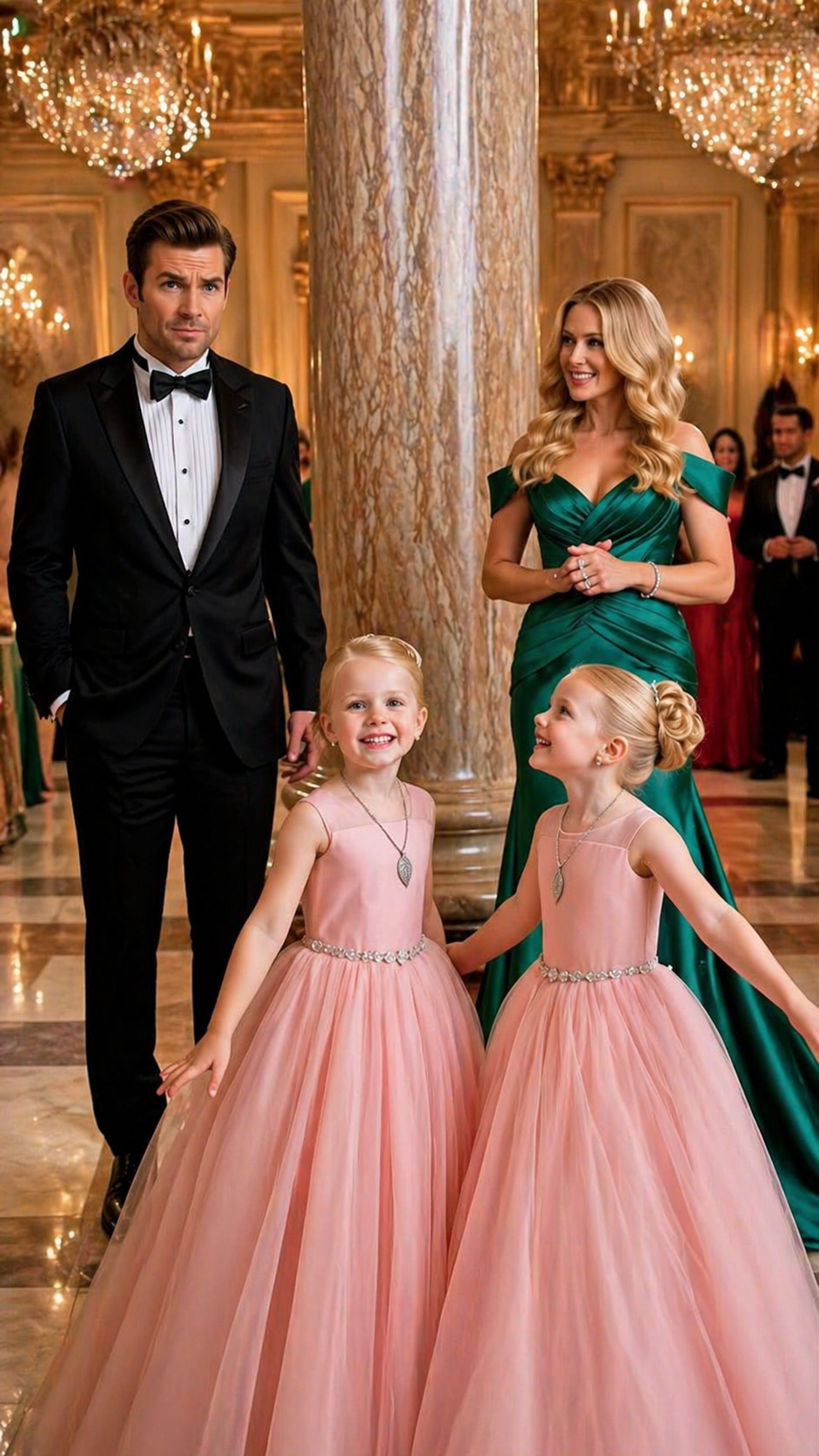
Finding a nanny on such short notice proved impossible. Sandra bathed the girls herself, carefully combed their light, almost platinum hair, and dressed them in the most exquisite dresses she had ever created—identical, soft pink tulle gowns with tiny bodices embroidered with pearls and sheer layers of fabric that shimmered softly with every movement. Then she again placed the silver leaf-shaped pendants around their necks—the very same ones that had been hidden under their collars for so many years.
Not out of faith in fate.
But because somewhere deep inside she felt: if it all started with these decorations, one day they would be seen again.
The ballroom at the Ashford Winter Benefit seemed like a world from another reality.
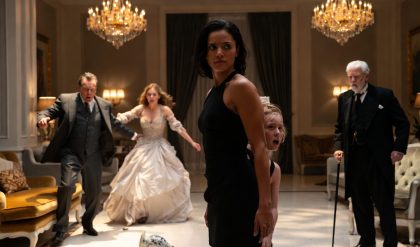
Crystal chandeliers bathed the space in cool white light, reflecting off the polished marble. Snow fell softly beyond the glass walls. The air was thick with the scent of roses, champagne, and old money—money that had long since forgotten the taste of poverty. Women in flowing silks glided effortlessly through the room. Men in formal dark suits engaged in hushed conversations that weighed on the fates and financial markets.
Sandra felt out of place in her simple black dress and discreet shoes. But as soon as Aria and Layla appeared next to her, heads held high and skirts swaying gently, the voices around them immediately fell silent.
“They’re like little princesses,” one of the women said quietly.
Sandra couldn’t help but smile.
She worked hastily in the side salon, hemming hems, adjusting seams, and reassuring her bewildered assistants. The girls remained nearby, near the marble column, where she could see them: they conversed in low voices and twirled, enjoying their outfits.
It was at this moment that Eli Ashford noticed them.
He stood at the far end of the room, surrounded by people who looked at him as if he were the center of their universe. At thirty-eight, the head of Ashford Biolabs had the perfect look for the covers of business magazines: dark hair, a strong mouth, a confident, commanding gaze. But today, there was a detachment in his expression—as if part of him had been trapped in some cold, inaccessible place.
Four years ago, the entire country was discussing his tragedy: a fire at the family estate. His wife, Isla, and newborn twin daughters were presumed dead. The bodies were never found. Empty coffins were buried under the winter sky. Newspapers called him either damned or a hero, broken or ruthless—depending on the public mood.
Sandra read these headlines once and never looked back at them again, as if they had nothing to do with her life.
Now this world was looking straight at her children.
Eli’s face changed instantly—as if the blood had suddenly drained from him. The glass fell from his hand and shattered on the marble floor with a dull clink.
Silence reigned in the hall.
He didn’t even seem to notice.
His gaze was fixed on the girls.
To their pink dresses.
To their hair.
To the way Lila throws her head back with a laugh, and how Aria almost instinctively reaches for her sister’s hand.
And then he saw the pendants.
Silver leaves.
He froze—and this silence was more terrible than any outburst of emotion.
“This can’t be…” he said barely audibly.
Sandra felt these words like a cold touch on her throat.
People turned around. Conversations died down completely. Eli took a step forward, then another, as if each step was an effort.
The girls noticed him at the same time.
Layla, fearless by nature, waved at him.
Aria, on the other hand, moved closer to Sandra, not quite understanding why.
Eli stopped right next to her. His eyes weren’t just dark—they were filled with pain.
“Where did they get these pendants?” he asked.
Sandra straightened, placing her hands on the girls’ shoulders protectively.
“They’ve always belonged to them.”
— Where did they get them?
The voice was quiet, but there was tension hidden in it.
— They were on them when I found them.
The hall seemed to freeze.
Eli’s gaze suddenly rose to her.
“Found it?”
— In Rose Hill. Four years ago. In a basket. During a storm.
For a moment, he seemed to lose his balance. And then anger flashed across his face—sharp and uncontrollable.
“Who are you?” he asked sharply.
— Sandra Whitlow.
— Did someone send you?
– No.
— Were you asked to dress them exactly like this?
“They always wore pink when they were kids,” Sandra replied, her voice shaking. “I made these dresses myself.”
His jaw tensed.
“You really think this is just a coincidence?”
She held his gaze, and a strength born only of motherhood appeared in her eyes.
“I don’t expect anything from you. But these are my daughters.”
There was such silence that even the musicians could no longer decide whether to play or not.
And at that moment another voice sounded.
— People.
The woman walking down the stairs looked like she had stepped out of a torn photograph and become flesh.
Sandra’s heart sank.
The same lip line.
The same cheekbones.
The same look.
That same half of her face that she had kept in a tin box all these years.
The woman descended slowly in a silver dress, her hand brushing the railing. Her beauty had become colder, sharper—polished by wealth and calculation. But there was no doubt.
It was her.
The woman from the photograph.
Eli spun around, barely keeping his feet.
“Vivian?”
The name sounded in the hall like a dry crack, cutting through the silence.
The guests began to exchange glances. A whisper was heard somewhere:
“Didn’t she die?”
Vivian smiled slightly, but her smile was cold, devoid of life.
“I didn’t die. I just… disappeared.”
Sandra felt her legs buckle.
For the first time, Layla pressed herself against her, hiding behind the folds of her skirt.
Aria stared at Vivian, unblinking, in mute amazement.
Eli’s gaze darted between the woman and the girls, as if what was happening were madness suddenly given form.
“How did you end up here?”
Vivian’s eyes settled on the twins, and for a moment her composure faltered. Something wild and desperate flashed across her expression.
“Because…” she said quietly, “Ayla was never your wife.”
The words sounded like a blow.
Sandra noticed Eli’s face turn white.
A murmur swept through the room, but Vivian continued, her every word cold and heavy.
“My sister married you under my name,” she said. “Our father was drowning in debts he couldn’t cover, and your council needed a Hawthorne heir to complete the deal. They wanted me. I fled. She stayed. She took my place… and my name.”
Eli looked at her as if reality itself had changed.
“Do you understand what you’re saying?”
Tears glistened in Vivian’s eyes, but there was no innocence in them – only tension and fear of exposure.
“The fire was deliberate. Your CFO did it. He found out the girls were alive and hadn’t yet been officially registered under Ayla’s false identity. If it had been revealed, the merger would have collapsed, the inheritance would have crumbled, and half the empire would have been a sham. He took the twins before the fire could get going. I found out too late.”
Eli opened his mouth, but couldn’t utter a word.
Sandra felt her hands trembling as they rested on the girls’ shoulders.
“I followed him,” Vivian continued, her voice beginning to break. “I tried to stop him. He handed me the basket and said that if I wanted the girls to live, I had to disappear and stay silent. He promised to leave them where they had a chance to survive.” She glanced at Sandra. “But I came back. I looked for them in that alley. The basket was gone.”
Sandra’s heart sank painfully.
“So you were the one who left the photo.”
Vivian nodded.
“I tore it apart, trying to hide it in the blanket before anyone noticed.”
Eli took a step back, as if the ground beneath him had become unsteady.
“You allowed me to mourn my children as dead.”
“I was sure they were dead!” Vivian cried. “I lived with that thought for years. And when I found out it might not be true, it was too late. He had proof—documents, records, everything that confirmed the fake marriage and the identity theft. He controlled us all.”
“Controlled?” Eli’s voice became harsh. “Where is he?”
There was no answer; instead, there was a slow, measured applause.
Everyone turned around.
An elderly man in a perfectly tailored tuxedo emerged from the shadows near the orchestra. His face expressed bored calm. Graham Pearce, CFO of Ashford Biolabs. Silver hair, impeccable posture, dangerous reserve.
“How awkward,” he said evenly. “I was planning on putting this off until later this evening.”
The guards moved towards him, but he raised his hand.
“Careful,” he said. “A message has already been sent that will be distributed to all the major financial publications. Documents, records, genetic data, property fraud, identity theft—a formidable collection. Touch me, and Ashford Biolabs will collapse by midnight.”
Eli’s face became stony and frightening.
“These girls,” Graham continued, looking at Aria and Lila, “were never a problem for me. They were a tool. And the woman who found them…” He glanced at Sandra with a slight smile, “was an unforeseen circumstance.”
Sandra hugged the twins.
“Don’t come any closer.”
Graham chuckled.
“You know what’s funny about all this? This whole time, the wrong person thought he’d lost his family.”
Eli frowned.
Vivian exhaled quietly:
“No…”
Graham’s smile widened.
“You still don’t get it?” he said. “These twins aren’t Eli’s daughters.”
There was a dead silence in the hall.
Eli turned to Vivian, his gaze filled with crushing pain.
But Graham didn’t stop:
– And they are not Sister Vivian’s daughters.
Sandra felt her breath catch.
Graham took an envelope from his inside pocket—old, yellowed, with burnt edges.
“I took this from the safe in the nursery the night of the fire,” he said calmly. “Sometimes the truth brings more benefit than money.”
He tossed the object carelessly forward. It slid across the cold marble and stopped at Sandra’s feet.
Her hands shook as she picked up the find.
Inside was a hospital bracelet.
Unfinished application for a birth certificate.
And another torn photograph.
This one was intact enough to be examined in its entirety.
Young Vivian. Her sister. And between them—
young Sandra: exhausted, scared, only seventeen years old, with two newborn babies in her arms in a hospital room.
Sandra’s gaze clouded over.
No.
No…
The memory didn’t return – it struck.
Shelter in Denver.
Childbirth under a false name.
Two twin girls born too early.
A social worker whispering promises.
Papers, the meaning of which remained unclear to her.
A man in a business suit insisting that the children were dead.
Sandra’s legs gave way.
Graham’s voice sounded as if from far away:
“You gave up your medical consent in exchange for housing after leaving the foster care system. An experimental surrogacy contract. Illegal, of course. On paper, the embryos were listed as assets of the Hawthorne family, and then transferred to the Ashfords’ structures after the transaction.” He bowed his head slightly. “But in essence? These girls were always yours.”
Aria burst into tears.
Layla clung to Sandra’s leg.
Sandra looked at the photo, at her youthful face, and the last locked door of her past swung open.
Foster family.
Cruelty.
Escape.
A pregnancy that was described to her as a “medical procedure.”
The children who were taken from her.
Pain hidden so deep that the only way to survive was by forgetting.
They were not abandoned.
They were not stolen from strangers.
They were taken from her. And then accidentally returned.
She raised her daughters on her own – and neither she nor they knew the truth.
Eli no longer looked like a billionaire—he looked like a man who suddenly realized his life had been built on a lie.
Vivian could no longer hold back her tears.
And Sandra, with a photograph in one hand and her daughters clinging to her in the other, looked up at Graham Pierce.
For the first time in many years, there was no doubt or confusion left in her soul.
Only the truth.
Burning, heavy, undeniable.
And when Graham allowed himself a smile—as if he thought the revelation had broken her—Sandra stood up, hugged Aria and Lila tightly, and said in a voice that cut through the room like a blade:
– So you should have made sure that I would be forgotten forever.