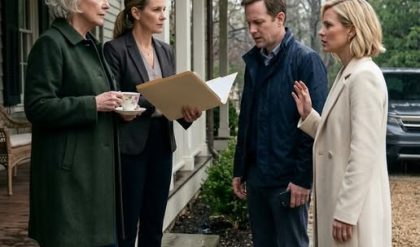
The Trust of Independence: The Day the Fireworks Burned Down the Sinclair Empire
The silence that blanketed the sprawling, manicured lawns of the Sinclair estate was absolute.
It was a suffocating, heavy stillness that seemed to suck the very oxygen out of the humid July evening.
Gone was the clinking of crystal flutes, the polite, calculated laughter of high-society matrons, and the booming, performative voices of local politicians vying for votes.
Even the gentle lapping of the Atlantic against the private dock seemed to hush itself, as if the ocean itself were waiting to see how the mighty Sinclair dynasty would collapse.
Vivienne remained on her knees, the pristine white silk of her designer jumpsuit staining a dark, muddy green against the damp clover.
Her perfectly coiffed, ice-blonde hair, which usually looked as though it could withstand a hurricane, had a few stray strands falling wildly across her face.
Her breathing was shallow, ragged, and loud in the quiet air.
“This is a mistake,” she whispered, her voice cracking, stripped of the sharp, aristocratic venom she usually deployed so effortlessly.
She looked up at the lead attorney, Mr. Harrison, her eyes wide with a mixture of terror and unadulterated denial.
“My father was Arthur Sinclair.
We are this town.
We built the hospital wing.
We funded the library.
You cannot evict me from my own ancestral home based on the delusions of a senile old woman!”
Mr. Harrison didn’t blink.
He stood like a pillar of granite, his tailored charcoal suit absorbing the golden light of the setting sun.
“Your father was indeed Arthur Sinclair, Mrs. Rhodes,” he replied, his tone devoid of any emotion, possessing only the cold, mechanical certainty of the law.
“And he was also a man who spent the last fifteen years of his life running a massive Ponzi scheme disguised as a boutique investment firm.
When the global markets crashed, he didn’t turn to his high-society friends.
He turned to his oldest friend from the military—Thomas Rhodes.
Your father-in-law.”
A low, collective murmur rippled through the crowd of five hundred guesTS. Heads turned, eyes darted, and the cell phones that Vivienne had banned to preserve her “aesthetic” were suddenly pulled from pockets and designer clutches.
The elite of the coastal elite were witnessing a public execution, and they were not about to miss a single second of it.
The True Architecture of the Sinclair Name
I watched my wife from a few feet away, my hands tucked into the pockets of my linen trousers.
For seven years, I had been the “fortunate” husband of Vivienne Sinclair.
To the outside world, I was the quiet, hardworking architect from a modest background who had married up, sneaking into the inner sanctum of old money through a combination of luck and standard devotion.
Vivienne never failed to remind me, privately and publicly, of the massive disparity between our worlds.
“Remember where you came from, Julian,” she would whisper whenever I questioned her extravagant spending or her dismissive treatment of our staff.
“My family gave you a name.
We gave you access.
Don’t ruin it by bringing your lower-middle-class morals into my household.”
I had endured it.
I had swallowed my pride because I loved the life we were building, and more importantly, I wanted to protect my mother, Martha.
When my father passed away, Martha refused to move into our mansion, opting instead for a tiny, immaculate cottage three towns over.
She didn’t want to be a burden.
She didn’t want to get in the way of Vivienne’s grand vision.
But today, for the Fourth of July, I had insisted.
“She’s eighty-two, Vivienne,” I had told her that morning as the caterers set up the raw bars and the champagne towers.
“She wants to see the fireworks over the water.
It reminds her of Dad.”
Vivienne had scoffed, checking her reflection in the gilded foyer mirror.
“Fine.
But keep her out of the main pavilion.
She wears those dreadful orthopedic shoes and talks to the catering staff like they’re her neighbors.
It throws off the vibe, Julian.
This isn’t a church basement potluck.”
And then, at three in the afternoon, when the heat index hit a brutal ninety-five degrees and the humidity made the air feel like wet wool, Vivienne had taken action.
She had found my mother sitting in the shade of the grand oak tree, holding her little American flag and quietly chatting with the wife of the town mayor.
Enraged by the “tacky” sight, Vivienne had marched over, grabbed Martha by her fragile, paper-thin arm, and led her to the unshaded, glass-enclosed sunroom patio at the western edge of the estate.
The glass magnified the sun like a greenhouse, trapped the heat, and offered no respite.
“You stay here, Martha,” Vivienne had commanded, her voice a sharp whisper that I caught from the hallway.
“The air conditioning inside is acting up, and we can’t have you fainting in front of the senators.
Julian will bring you some water later.”
She hadn’t brought water.
She had locked the heavy French doors from the inside, claiming the latch was broken, leaving an eighty-two-year-old woman to bake in the sweltering heat for hours, visible only as a silhouette behind the tinted glass.
When I finally found out and broke the lock to pull my mother out, Martha wasn’t crying.
She wasn’t yelling.
She was deeply flushed, her hands were trembling, but her green eyes were as sharp as diamonds.
She had looked at the grand mansion, then at Vivienne, who was currently clinking glasses with a shipping heir, and pulled a small, outdated flip phone from her knitted purse.
“Mr. Harrison,” my mother had said quietly into the receiver, her voice steady despite the heat exhaustion.
“The grace period ends at four o’clock today, correct? Yes.
Execute the lien.
Call the sheriff.
It’s time to clean house.”
The Unraveling of a Illusion
“Julian!” Vivienne suddenly shrieked, snapping me back to the present.
She crawled a few inches forward, her manicured nails digging into the dirt, looking up at me with a terrifying desperation.
“Tell them! Tell these men to leave! Call Arthur Pendleton, our corporate council.
This is a harassment campaign.
Your mother is senile, she doesn’t know what she’s doing!”
My mother, Martha, stepped out from the shade of the veranda.
She had replaced her sweat-stained blouse with a fresh, simple cotton shirt.
In her hand, she held a glass of the expensive vintage champagne that Vivienne had flown in from France especially for the occasion.
She took a slow, deliberate sip, looking down at the kneeling billionaire as if she were looking at a stray dog that had made a mess on her rug.
“My mind is perfectly intact, Vivienne,” Martha said, her voice carrying a deep, resonant strength that shocked everyone who had dismissed her as a fragile grandmother.
“Unlike your family’s bank accounTS.”
Mr. Harrison opened the leather portfolio wider, pulling out several pages of certified public records and financial ledgers, holding them out so the guests in the front row could clearly see the official state seals.
“For twenty-five years,” Mr. Harrison explained to the entire gathering, “the Sinclair Family Trust has been a hollow shell.
When your father, Arthur Sinclair, faced total ruin and federal prosecution in 1999, Thomas Rhodes used the entirety of his life savings—capital earned from his highly successful engineering patents—to buy out the debt.
He didn’t do it for profit.
He did it because Arthur Sinclair had saved his life in a foxhole in Vietnam.”
The audience gasped.
The mayor’s wife covered her mouth, her eyes darting between Vivienne and Martha.
“The agreement was simple,” the attorney continued.
“The Sinclairs would retain the appearance of wealth and management of the estate, provided they paid a nominal quarterly interest back into the Rhodes foundation, which funds military veterans’ housing.
For twenty-four years, that agreement was honored.
But when your father passed away and you took over the trust, Mrs. Rhodes, you stopped paying.
You missed one quarter.
Then two.
Then a year.
You ignored every legal warning, every notice of default, believing that your family name made you untouchable.”
Vivienne’s mouth opened and closed, but no sound came out.
She looked at her sister-in-law, Paige, who was standing near the pool house, but Paige immediately turned her back, pretending to be deeply invested in her phone.
The fair-weather friends who had populated Vivienne’s life for decades were already retreating, drifting toward the edges of the property like smoke in the wind.

“The grace period for the final cure notice expired exactly two hours ago, at four o’clock,” Mr. Harrison said, looking at his gold watch.
“As the primary trustee and sole heir of the Thomas Rhodes estate, Martha Rhodes has elected not to grant an extension.
The foreclosure is finalized.
The ownership of this house, the land, the dock, and the two yachts moored at the marina has officially transferred to her.”
The Final Hour
Two local sheriff’s deputies, dressed in crisp brown uniforms, stepped out from the shadow of the grand foyer, their boots echoing loudly on the stone steps.
They didn’t look at Vivienne with respect; they looked at her with the professional indifference reserved for any standard eviction.
“Mrs. Rhodes,” the lead deputy said, addressing Vivienne.
“Per the court order attached to the deed transfer, you have exactly sixty minutes to clear your personal effects from the primary residence.
Anything left behind after eight-thirty p.m.
will become the property of the new deed holder or will be disposed of at her discretion.”
Vivienne finally found her feet.
She stood up, her body shaking so violently that she had to grab the back of a lawn chair to keep from collapsing.
The arrogance that had defined her entire existence was entirely gone, replaced by a raw, naked panic.
“Julian,” she begged, reaching out to touch my arm, her voice a frantic, low whisper.
“Please.
Talk to your mother.
We’re married.
Everything I have is yours.
If I lose this house, we lose it.
Think about our reputation.
Think about our future!”
I looked at her hand on my arm.
For fifteen years, I had loved this woman.
I had forgiven her flaws, her snobbery, her sharp edges, believing that deep down, there was a human being capable of real warmth.
But when I looked at the glass patio behind her, remembering my mother trapped in ninety-five-degree heat while Vivienne drank champagne, the last ember of my affection died.
“We don’t have a future, Vivienne,” I said, my voice dropping to a calm, dead tone that made her freeze.
“I filed for divorce this morning at nine a.m.
The papers are sitting on the desk in the study.
I was going to wait until tomorrow to show you, out of some lingering respect for the years we spent together.
But after what you did to my mother today? You’re lucky I’m letting you walk out of here with your suitcases.”
Vivienne stumbled back, her eyes darting between me and Martha.
“You… you knew? You knew about the trust the whole time?”
“I didn’t know the full extent until two weeks ago when my mother’s lawyers contacted me to review the property deeds,” I said.
“But even if I had known, I wouldn’t have stopped her.
You spent years treating my family like grease on your polished world.
You thought my mother was a helpless nobody because she didn’t wear diamonds or care about social media metrics.
You forgot that the money you used to buy your lifestyle was built on the quiet sacrifice of people who actually worked for a living.”
Martha stepped forward, placing her glass of champagne down on the very table where the catered lobster rolls were beginning to warm in the evening air.
She looked at the sheriff’s deputies, then at Vivienne.
“Your hour is ticking, Vivienne,” Martha said softly, her green eyes reflecting the first sparks of the town’s holiday fireworks starting to explode over the harbor.
“I suggest you start with your closet.
I hear the traffic out of town is dreadful on the Fourth of July.”
The Exodus of the Elite
What followed was a masterclass in the brutal social calculus of high society.
The moment it became clear that the Sinclair name was dead, the five hundred elite guests didn’t offer condolences; they offered a stampede.
Within fifteen minutes, the grand lawn was entirely empty.
Valets rushed to bring up Ferraris, Bentleys, and Range Rovers, the tires kicking up dust and gravel as the wealthy patrons fled the scene of the financial crime.
The caterers, realizing who was actually holding the checkbook, walked over to Martha, bowed respectfully, and asked if she wanted the remaining food packed or distributed to the local community kitchen.
“Pack it for the shelter downtown, please,” Martha told the head chef, offering a warm, genuine smile.
“And make sure your staff takes a full bonus from the primary account.
You’ve worked hard today.”
By eight-fifteen, the estate was dead silent, save for the booming echoes of the town’s fireworks display filling the night sky with brilliant bursts of red, white, and blue.
Vivienne descended the grand marble staircase of the foyer, dragging two massive, mismatched designer suitcases behind her.
She was alone.
No assistants, no friends, no sister-in-law to help her lift the weight of her collapsed life.
She reached the front door, where the two sheriff’s deputies stood like sentinels, and looked back at the grand crystal chandelier one last time.
She looked at me, standing beside my mother on the veranda.
She didn’t scream.
She didn’t beg.
She simply looked like a ghost trapped in a world that had suddenly deleted her from the narrative.
She walked out the door, the heavy iron hinges clicking shut behind her with a sound that felt like the closing of a tomb.
Martha turned to me, her small American flag tucked safely into her blouse pocket, and reached out to take my hand.
Her skin was cool, her grip firm and filled with the unshakeable resilience of a generation that knew how to survive.
“Come on, Julian,” my mother said, turning her back on the empty mansion and looking out toward the ocean, where the final, grand finale of the fireworks was lighting up the dark water.
“Let’s sit on the patio.
The weather is absolutely beautiful now.”
The End