The Key to the Past
Leticia’s shrill voice continued to echo off the pavement, her theatrical performance drawing more neighbors to their windows.
She looked triumphant, convinced that by painting me as the aggressor, she could force us to submit.
She had spent decades ruling her world through fear and public shame, and she was certain that if she screamed loud enough, we would eventually collapse.
Andrés didn’t shout back.
He didn’t even raise his voice.
He simply took his phone out, opened a file, and pressed a single button.
Leticia’s own voice blasted from the speakers, raw and unfiltered.
“When that boy grows up to be a criminal, don’t come looking for me.” Then came the next one.
“Someone had to teach him discipline.”
The neighbors who had been filming on their phones slowly lowered them.
The murmurs began—not in her favor, but in collective horror.
“You want to talk about education, Mom?” Andrés’s voice was deathly quiet.
“Let’s talk about your own education.
I didn’t know why I could never sleep in a dark room until I was twelve.
I didn’t know why I used to vomit every time you told me to ‘go to the closet’ when I made a mess.
I thought I was just a difficult child.
I thought there was something inherently wrong with me.”
Leticia froze.
The mask of the “wronged grandmother” slipped, revealing a flicker of genuine terror.
“That… that was different,” she stammered, her gaze darting away from his.
“You were a stubborn boy.
You needed to learn!”
“I was five,” Andrés said, his voice trembling now with decades of repressed agony.
“And Mateo is four.
The only thing you’ve ever taught us is that we are not safe with you.
That we are just objects for you to break and fix whenever you lose your temper.”
He stepped off the porch and walked right into her personal space.
“I have spent my entire life trying to be the son you wanted.
I have apologized for your behavior to every friend, every partner, and every neighbor you’ve alienated.
But that stops today.
I have the medical records from the doctor we took Mateo to this morning.
He has been diagnosed with acute stress response.
That is a legal term, Mother.
And it comes with consequences.”
Leticia’s face turned a ghostly shade of grey.
She finally realized this wasn’t about control; it was about survival.
“You wouldn’t,” she whispered.
“I’m your mother.”
“You are a woman who hurts children,” I added, stepping beside Andrés.
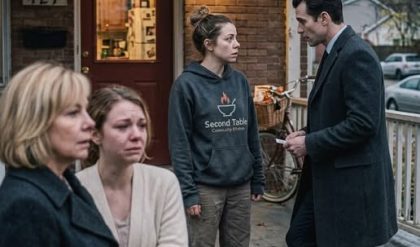
“And the police are already on their way to take your statement.
Not about the ‘attack’ you claim happened, but about the endangerment of a minor.
We have the voicemail, we have Mateo’s testimony, and we have the history of your ‘discipline’ that Andrés finally found the courage to document.”
 The Trap of the Cold Mole: The Day the Silence Broke
She didn’t wait.
She turned and fled toward her car, her movements frantic and pathetic.
She knew that the neighborhood she had used to intimidate us was now a witness to her downfall.
The following months were a blur of legal battles and deep, restorative healing.
We didn’t just get a restraining order; we built a fortress around our son’s sense of self.
Mateo started play therapy, and slowly, the light returned to his eyes.
He stopped checking the closeTS. He stopped asking if the doors were locked.
We turned the downstairs closet into a pantry, tearing out the door entirely so it could never be a place of fear again.
Andrés was a different man.
The weight of his mother’s shadow—the belief that he was ‘defective’ because of the way he was raised—evaporated.
He realized that the only person who was broken was the woman who had tried to build a kingdom on the suffering of her own flesh and blood.
Leticia was eventually sentenced to community service and mandatory anger management, but she lost everything else.
No one in the family wanted to be associated with her after the recordings were leaked.
She became a prisoner of her own making, sitting in a large, empty house, waiting for visitors who would never arrive, holding onto a power that had long since withered into nothing.
A year later, on a sunny Saturday afternoon, I watched Mateo playing in the backyard.
He was chasing a butterfly, his laughter ringing out like a silver bell.
Andrés sat on the grass beside me, his hand in mine.
There was no tension, no “walking on eggshells,” no fear of an impending visit or a critical phone call.
Mateo ran over and collapsed into my lap, breathless and happy.
He leaned into me, looked up at his father, and then asked, “Can we leave the door open?”
Andrés smiled, kissed his forehead, and said, “The door is always open, buddy.
You’re safe here.
Always.”
I looked at my husband and my son, and for the first time, I felt the sharp edges of my own resentment soften into peace.
We had been tested by a woman who believed that love was synonymous with submission, but we had chosen differently.
We had chosen truth, we had chosen healing, and above all, we had chosen each other.
The cycle of fear had ended with us.
Leticia had tried to create a legacy of discipline and darkness.
Instead, she had only succeeded in creating the very family that would eventually turn the lights on, break down the doors, and leave her in the cold, hollow silence of her own consequences.
THE END