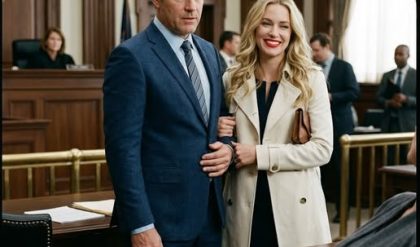
The Final Audit of Grant Whitfield
The silence in the boardroom the next morning was absolute, a stark contrast to the hollow arrogance Grant had displayed at the gala.
He sat at the head of the table, his suit looking sharper than his future.
He still held onto the delusion that he could intimidate the room back into submission, but his eyes were darting toward the door every time a lawyer walked in.
When I entered, the atmosphere shifted.
I wasn’t the “furniture” in a navy dress anymore.
I walked to the table and placed a thick, leather-bound binder—the real one—in front of Calvin Moore.
The board members were silent, their faces unreadable, but their posture toward me had changed.
They looked at me with the kind of focus one reserves for a primary stakeholder.
“Gentlemen,” I began, my voice steady, echoing off the mahogany walls.
“You are here because of a discrepancy in capital ownership and a breach of fiduciary duty.”
Grant stood up, his face flushed with a desperate, frantic energy.
“She’s delusional! This is a domestic dispute, not a corporate takeover!”
Calvin didn’t even look at him.
He was already flipping through the pages of the binder, his eyebrows raising with every new exhibit of Grant’s systematic embezzlement.
“Nora,” Calvin said, his voice quiet but carrying the authority of a man who controls millions, “these records of the consulting fees paid to Ms.
Vale… they are categorized as ‘business development’?”
“They are categorized as ‘personal enrichment,'” I corrected him, stepping into the center of the room.
“And they are substantiated by the internal bank logs from the accounts Grant thought were strictly his own.”
 Kapitel 3: Das Kartenhaus stürzt ein
Grant lunged forward, but security was already there.
He was silenced not by violence, but by the cold, hard reality of the documenTS. He had spent years playing a game where he thought he was the only one who knew the rules, never realizing that I had been the one who wrote the ledger.
As they escorted him out, he looked at me—not with anger, but with a terrifying, hollow recognition.
He finally understood that he hadn’t just lost a company; he had lost the only person who had ever truly seen his potential, and in his greed, he had discarded it like trash.
He was left with nothing but his own empty reflection.
I didn’t stay for the final vote.
I left the boardroom, the building, and the life I had spent eleven years suffocating within.
I drove to the little lake house my grandmother had left me—the one I had mortgaged to save him, which I had secretly bought back through a shell company months ago.
I sat on the deck, listening to the water lap against the shore.
The phone in my purse didn’t buzz; there were no more midnight texts, no more hidden receipTS. The house was mine.
The company was being restructured.
And most importantly, my hands weren’t bleeding anymore.
I wasn’t standing behind the curtain; I was the one directing the stage.
THE END