The Echo of a Stolen Life
The arrival of the authorities transformed the upscale restaurant into a fortress of truth.
As the flashing blue lights illuminated the grand windows, Alejandro Santillán’s veneer of untouchable power finally began to blister.
He tried to gesture to his security team, but the officers were already moving with a speed that suggested they had been waiting for exactly this moment.
“Mr. Santillán, you are under arrest for kidnapping and conspiracy,” a lead detective announced, his voice booming over the sudden, sharp silence.
The woman in black, whose name I later learned was Beatriz, let out a jagged, hysterical laugh.
“You have no proof! She is a Santillán! Look at her clothes, her life, her pedigree! Who would believe a waitress over us?”
“I would,” a voice cut through the air.
The nanny, shivering as if recovering from a long, cold fever, stepped forward.
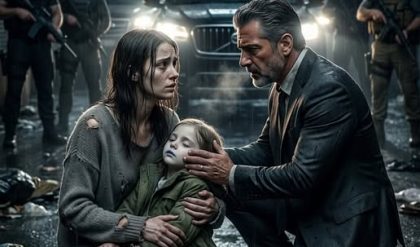
She looked at Alejandro, then at the little girl trembling in my arms.
“I have the logs, Alejandro.
I have the medical transfers from Guadalajara.
I kept them… in case I ever needed a way out.”
Alejandro’s face drained of color, his predatory poise replaced by the frantic darting eyes of a cornered animal.
He looked at me, then at Valeria, and for a fleeting second, I saw a flicker of something that wasn’t just greed.
It was a hollow, desperate loneliness—a man who had bought an heir because he was too incapable of love to ever earn one.
“She’s mine,” he whispered, his voice cracking.
“I gave her everything.”
“You gave her a cage,” I retorted, clutching Valeria closer to my chest.
“You stole her from the only person who knew she was a miracle.”
The arrest was a blur of steel cuffs and aggressive questions.
As they dragged Alejandro away, he didn’t look at his empire or his lawyers; he looked back at Valeria one last time, a pathetic, discarded king watching his crown roll into the gutter.
The ensuing legal firestorm was a descent into the dark heart of a billionaire’s privilege.
The investigation uncovered a cold, industrial operation.
In Guadalajara, the clinic was not a hospital but a clearinghouse.
Wealthy, desperate men and women paid exorbitant fees to the corrupt administrator, who targeted vulnerable mothers in maternity wards, declared their babies dead, and sold the infants to the highest bidders.
For weeks, I lived in the center of a storm.
I had to undergo DNA testing, provide testimony, and relive the agonizing night in the recovery room when they had handed me that sealed, empty box.
Every time I looked at the charcoal they had given me—the “ashes” of my daughter—the rage would flare, followed immediately by the overwhelming, quiet grace of having her back.
Valeria—my Sofia, the name I had given her long ago—was a fragile, beautiful puzzle.
The trauma of her sudden transition from a gilded cage to the truth left her withdrawn.
She didn’t speak for a long time.
She would sit on the rug of our temporary apartment, clutching that worn cloth doll, staring at the wall.
“I’m here, Sofia,” I would whisper, sitting beside her.
“You are safe.
The story is different now.”
I started reading to her from the books I had saved in my heart for three years.
I told her about the ocean, about the way stars looked in the countryside, and about the father she never knew, who had been a good man, gone too soon.
Slowly, the walls she had built around her soul began to thin.
The breakthrough happened on a Tuesday, three months after the arresTS. We were in the small garden behind the house I had rented, far away from the prying eyes of the press.
A butterfly, vibrant and blue, landed on the sleeve of her dress.
She watched it, her breath hitching, and then she turned to me, her eyes clear for the first time.
 The Truth Behind the Silence
“Mommy,” she said, her voice like a small, sweet bell.
“Does it have a name?”
I cried then.
I cried until I had no breath left, holding her as if she might evaporate into the sunlight.
As the months turned into a year, the courtroom battles finally concluded.
Alejandro Santillán was sentenced to twenty years in a maximum-security prison.
His sister, Beatriz, was given fifteen, and the corrupt administrator disappeared into the shadows of the federal system.
Their wealth was seized, and a significant portion was directed toward a foundation for the victims of the Guadalajara clinic—a small, necessary justice for the mothers who never got their babies back.
I left the city behind.
The fame, the sensationalist headlines, and the lingering stares of strangers were too much for Sofia to bear.
We moved to a quiet town nestled in the mountains, a place where the air tasted like pine and the only schedules were dictated by the rising and setting of the sun.
I opened a small bakery.
It wasn’t grand, but it smelled of cinnamon and fresh bread, and the locals were kind.
Sofia thrived.
She became a girl of color and noise; she painted, she ran through the tall grass, and she learned that her voice was a gift, not a burden.
She still held that worn cloth doll sometimes, but now it sat on a shelf next to newer, brighter toys—a relic of a life that had been stolen but eventually returned.
One evening, as the sky turned a deep, bruised purple, we sat on our front porch.
Sofia was drawing in her sketchbook, her tongue poking out of the corner of her mouth in concentration.
She looked up at me, a smudge of charcoal on her nose, and leaned her head against my knee.
“Mommy?”
“Yes, my love?”
“Are we happy now?”
I looked at the house, at the quiet life we had built from the fragments of our broken past, and I reached out to touch that tiny, flower-shaped birthmark on her cheek.
It was a map of everything I had lost and everything I had fought to reclaim.
“We are more than happy, Sofia,” I said, pulling her into my arms.
“We are whole.”
The wind rustled through the trees, carrying the scent of jasmine and the promise of a night filled with peaceful dreams.
The secrets were buried.
The monsters were behind bars.
And here, in the quiet sanctuary of our own making, the only thing that mattered was the steady, rhythmic beat of her heart against mine.
Our real life had begun, and for the first time in three years, I knew with absolute certainty that no one could ever take it from us again.
THE END