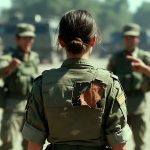
I was only nineteen when I stood on that scorched Nevada ridge, but the look of absolute contempt from the twelve Navy SEALs around me told me everything I needed to know about how this day would go.
They didn’t see a highly trained marksman who had spent her entire childhood tracking targets across the frozen mountains of Montana.
They just saw a teenage girl who looked like she belonged in a college library rather than holding a fifty-pound anti-materiel sniper rifle on a Tier-1 special operations training ground.
The heat coming off the desert floor was suffocating, rising in thick, wavy sheets that distorted the horizon into an unrecognizable blur.
The air smelled of dry dust, sagebrush, and the sharp, metallic tang of spent cordite from the morning’s firing exercises.
Standing in the center of the concrete pad was Master Chief Miller, a towering man with a heavily bearded face, deeply tanned skin, and eyes that looked like they had been chiseled out of flint.
He had spent twenty-four years in the Teams, surviving ambushes in every hostile corner of the globe, and he made no effort to hide his displeasure at my presence.
“Listen up, kid,” Miller said, his voice sounding like two heavy stones grinding together.
He didn’t use my rank, and he certainly didn’t use my name.
“I don’t know whose ego we’re massaging by letting you out on this range today, but this isn’t some high school shooting club.
This is a live-fire evaluation for operational deployment support.”
The men behind him, a group of seasoned operators whose bodies were covered in tattoos and the scars of a dozen deployments, let out a collective chuckle.
One of them, a massive sniper named Jackson who held the platoon’s record for long-range interdiction, leaned against a wooden crate with his arms crossed.
“Careful, Master Chief,” Jackson called out, a smirk playing on his lips.
“The wind out there is pushing twenty knots from the east.
If she pulls that trigger, the recoil might just throw her all the way back to the logistics depot.”
I didn’t answer them, and I didn’t let my expression change.
If there was one thing my grandfather taught me before he passed away, it was that anger is a waste of energy on a firing line.
When you are looking through a high-magnification scope, even the slightest tremor caused by a racing heart or a surge of adrenaline will move your crosshairs by yards at extreme distances.
You have to be a ghost.
You have to let your emotions die before your finger ever touches the metal of the trigger.
I adjusted the straps of my tactical vest, which was admittedly slightly too large for my frame, and walked toward the designated shooting lane.
Resting on the heavy wooden bench was my weapon of choice: a custom-built McMillan TAC-50 rifle, chambered in the massive .50 BMG cartridge.
It was a beautiful, brutal machine capable of stopping a vehicle from over a mile away, but in the hands of someone who didn’t respect it, it was nothing more than an expensive club.
“The target is the steel silhouette at eighteen hundred yards,” Miller said, walking up beside me with a high-powered spotting scope clutched in his hand.
“Jackson spent the last two hours trying to find the center mass, and even he only managed to nick the edge twice out of ten rounds.
The thermal mirage down in the ravine is creating a massive optical illusion.
What you think you see down there isn’t where the target actually is.”
I looked out across the valley.
Eighteen hundred yards was just over a mile.
To the untrained eye, the target was completely invisible, hidden somewhere in the deep shadows of a jagged rock formation at the base of a distant mountain range.
The wind was howling through the canyon, shifting direction every few seconds as it bounced off the canyon walls.
“You want me to take the shot from the bench, Master Chief?” I asked, keeping my voice entirely flat and devoid of any intimidation.
Miller blinked, seemingly surprised that my voice wasn’t shaking.
“Take it however you like, Sergeant.
Just don’t waste my ammunition.”
“I’ll take the dirt,” I replied.
I picked up the heavy rifle, its weight pulling hard against my shoulder muscles, and stepped off the concrete pad onto the loose gravel of the ridge.
I carefully lowered myself into the prone position, stretching my legs out behind me and digging the toes of my combat boots into the earth to create a stable anchor.
The ground was hot against my chest, the heat soaking through my uniform within seconds, but I welcomed it.
It gave me a physical sensation to focus on, a way to ground myself in the present moment.
I extended the heavy metal bipod at the front of the rifle, settling the feet deep into the loose gravel until the weapon felt rock-solid.
Behind me, the SEALs had gone quiet, though I could still hear the faint sound of their footsteps as they gathered around to watch the show.
They were waiting for the failure.
They were waiting for the massive recoil of the .50 caliber round to slam into my shoulder, bruise my collarbone, and force me to give up.
“Hey Jackson,” one of the men whispered loudly.
“Ten bucks says she misses the entire mountain.”
“No bet,” Jackson replied smoothly.
“The wind just picked up to twenty-five knoTS. She doesn’t even know how to calculate the spin drift at this range, let alone the windage.”
I ignored them.
I opened the bolt of the TAC-50, sliding a single, heavy match-grade round into the chamber.
The metallic clink of the bolt closing sounded incredibly loud in the heavy desert air.
I placed my cheek firmly against the adjustable riser on the stock, aligning my right eye perfectly with the glass of the high-end Nightforce scope.
The world immediately changed.
The vast desert vanished, replaced by a circular field of view dominated by a complex grid of fine black lines—the reticle.
I dialed the magnification up, searching through the heavy, shimmering heat waves that distorted the landscape.
It was exactly as Miller had warned.
The air looked like liquid glass, boiling and swirling over the valley floor.
The target, a white steel plate shaped like a human torso, was barely visible through the distortion.
It appeared to be dancing, shifting left and right as the thermal currents rose from the sun-baked rocks.
To hit a target under these conditions, you cannot aim at what your eyes are seeing.
You have to calculate the physical reality of the bullet’s flight path through the air.
At eighteen hundred yards, the bullet would take nearly three full seconds to reach the destination.
During those three seconds, the wind would push it, gravity would pull it down in a massive, curving arc, and even the rotation of the earth itself would gently nudge the trajectory.
I began the mental math, my brain working through the variables that had been drilled into me through thousands of hours of practice.
The wind was blowing from my nine o’clock position, but halfway down the valley, near a deep dry creek bed, the dust patterns showed that the wind was actually swirling back in the opposite direction.
“She’s taking too long,” one of the operators muttered behind me.
“She’s freezing up.”
“Let her be,” Miller said, his voice entirely neutral now.
“She requested the lane.
She gets her time.”
I adjusted the elevation turret on top of the scope, feeling the distinct, mechanical clicks beneath my fingers.
Click.
Click.
Click.
Then I adjusted the windage turret, holding a specific offset in my mind based on the movement of the sagebrush in the mid-range valley.
I took a deep breath, filling my lungs completely, and then let half of it out.
I held the remaining air in my chest, allowing my body to become entirely still.
I closed my eyes for a fraction of a second to reset my vision, then opened them again.
The reticle was steady, resting on a point several feet above and to the left of where the actual target appeared to be through the mirage.
My finger gently contacted the curved metal of the trigger.
I didn’t pull it.
I simply applied a slow, steady increase in pressure, letting the weapon surprise me when it finally fired.
BOOM.
The roar of the rifle was deafening, a massive shockwave of sound that tore through the air and pressed hard against my chest.
The muzzle brake redirected the burning gasses to the sides, kicking up a massive cloud of dust and small rocks that completely obscured my vision for a split second.
The heavy recoil slammed into my right shoulder, but because my body was perfectly aligned, the force travelled straight down my spine and into the earth, keeping the rifle perfectly on target.
I immediately cycled the bolt, ejecting the smoking brass casing and loading a second round into the chamber without ever taking my eye away from the scope.
One second passed.
Two seconds passed.
Behind me, Miller was staring through his high-powered spotting scope.
The rest of the SEAL team stood completely motionless, their eyes fixed on the distant mountain side.
Then, a faint, metallic sound echoed back across the mile of open desert.
CLANG.
“Holy shit,” Miller breathed, his body freezing in place behind the spotting scope.
“Dead center.
She hit the exact center of the plate.”
The silence that followed was absolute.
The whispering stopped.
The smirks vanished.
I could hear the wind whistling through the dry brush, but from the elite operators behind me, there wasn’t a single sound.
Jackson slowly lowered his arms, his eyes wide as he stared at my small form lying in the dirt.
“An accident,” Jackson muttered, though his voice lacked any real conviction.
“A lucky shot.
The wind must have dropped right when she pulled it.”
I didn’t say a word.
I didn’t look back at him.
Instead, I focused my eyes back into the scope, looking past the white steel target toward a completely different sector of the valley, near an old, abandoned concrete observation bunker that had been used during the Cold War.
Something had caught my eye.
A tiny movement that didn’t match the natural swaying of the sagebrush or the swirling of the dust.
I adjusted my focus, shifting the heavy rifle several degrees to the left, away from the approved training grid.
Miller noticed the movement immediately.
“Sergeant, what are you doing?” he asked, his tone suddenly sharp and authoritative.
“The exercise is over.
Keep your weapon pointed downrange at the designated targeTS.”
“Master Chief, look at the old observation bunker at grid three-two,” I said, my voice cold and steady.
“Near the crumbling concrete wall.”
Miller frowned, but he instinctively swung his powerful spotting scope toward the location I specified.
For a few seconds, he was silent, adjusting the focus wheel on his high-end optics.
Then, I heard his breath catch in his throat.
“What is that?” Miller whispered, his voice completely stripping away the hardened, robotic tone of a special operations commander.
“Oh God.
Is that…?”
Through my high-magnification lens, the image became terrifyingly clear.
A German Shepherd—a search and rescue dog wearing a faded orange tactical harness—was frantically digging at a pile of collapsed concrete debris near the edge of an old, unsecured test pit.
But that wasn’t what caused the blood to turn to ice in my veins.
Clinging to the dog’s harness, her small fingers buried deep in the thick fur, was a little girl.
She couldn’t have been more than six years old, wearing a pink jacket that was now covered in dark desert dust.
They were completely out of bounds, miles away from the public hiking trails, having somehow wandered onto the active, live-fire military reservation.
The dog was pulling hard, trying to drag her away from the edge, but the ground beneath them was giving way.
The heavy rains from the previous week had undermined the old concrete structure, and a massive, shifting slab of stone was slowly tilting right above the deep, dark opening of the forgotten shaft.
“Cease fire! Cease fire!” Miller roared into his radio, his face turning pale beneath his tan.
“We have civilians downrange! I repeat, civilians in the impact zone!”
But the radio only sputtered with loud, harsh static.
The deep canyons and heavy mineral deposits in the mountains were notorious for creating massive communication dead zones, and today was the worst it had ever been.
“The heavy mortar team on the eastern ridge,” Jackson said, his face suddenly full of panic as he looked up at the high peaks.
“They’re scheduled to start a high-explosive barrage on that exact sector in less than two minutes.
They don’t have eyes on the bunker from their angle.”
“We can’t reach them,” another operator said, desperately hammering the buttons on his tactical radio.
“The signal isn’t getting through the ridge.”
The little girl down in the valley was crying, her small face twisted in terror as the ground beneath her feet crumbled further.
The German Shepherd let out a sharp bark, its paws slipping on the loose shale as the massive concrete slab above them shifted another few inches, preparing to slide down and crush them both.
Miller looked down at me, the absolute authority of a Master Chief completely vanishing, replaced by the desperate eyes of a father.
“Sergeant,” Miller whispered, his hand trembling slightly as he pointed toward the distant valley.
“Can you hit the structural support pin on that old retaining wall? If you shoot it out, the wall will collapse away from them, blocking the path of the sliding slab.
But if you miss by even an inch… you’ll hit the dog or the child.”
I looked through the scope.
The distance was nineteen hundred and fifty yards.
The wind was swirling violently inside the canyon mouth.
It was a shot that defied every rule in the military handbook.
I clicked the safety off.
CHAPTER 2
The metallic click of the safety selector switching to the “fire” position was the loudest sound on that mountain ridge.
It was a tiny, definitive snap of steel against steel, but it instantly froze the air around us.
Just minutes ago, these men were laughing.
They were checking their watches, making bets on how badly a nineteen-year-old girl would flub a long-range demonstration, and treating the entire afternoon like an unwelcome distraction from their real training.
Now, the atmosphere had mutated into something thick, heavy, and suffocatingly tense.
Master Chief Miller remained bent over his spotting scope, his knuckles turning white as he gripped the aluminum tripod.
His chest was heaving, his breathing shallow and rapid.
The hardened, unshakeable demeanor of a man who had commanded elite operations across three continents had completely evaporated.
In its place was a father looking at a nightmare.
“Talk to me, Sergeant,” Miller whispered, his voice dangerously low, stripped of all its previous gravelly arrogance.
“Tell me you have eyes on the pin.
Tell me you can see it through that glass.”
I didn’t answer right away.
I couldn’t.
Every single ounce of my cognitive energy was being funneled into the small, circular world inside my Nightforce scope.
The heat waves rising from the valley floor were brutal.
At nineteen hundred and fifty yards, the atmosphere wasn’t just a transparent gas; it was a living, breathing obstacle.
The thermal currents looked like heavy sheets of distorted glass, constantly warping, bending, and twisting the image of the old concrete observation bunker.
Through the shimmer, I could see the German Shepherd.
The dog was a magnificent, intelligent animal, its muscles straining as it dug its front paws into the shifting gravel, its teeth locked onto the thick fabric of the little girl’s pink jacket.
The dog knew.
Animals have an inherent understanding of gravity and instability that humans often lack.
It knew the ground was dying beneath them.
Directly above them, the massive reinforced concrete slab—a remnant of a structural roof that had collapsed decades earlier—was balanced on a knife-edge of crumbling masonry.
It weighed at least three tons.
If it slid, it wouldn’t just crush them; it would sweep them directly into the hundred-foot-deep vertical test shaft below.
And then there was the pin.
It was an old, heavy structural anchor, a three-inch-thick rod of rusted industrial steel protruding from the primary retaining wall twenty feet to the left of the bunker.
If a high-impact round struck that exact pin with enough kinetic energy, the structural integrity of the retaining wall would fail, causing the western half of the masonry to collapse outward, away from the test pit.
That secondary collapse would create a natural rockslide barrier, wedging itself beneath the tilting roof slab and locking it into place.
It was a beautiful, theoretical engineering solution.
But executing it meant firing a fifty-caliber bullet past a child’s shoulder at a distance where a single heartbeat could throw the trajectory off by six feet.
“Jackson,” I said, my voice cutting through the silence of the ridge like an ice pick.
“Give me a localized wind reading at the mid-valley gap.
Right now.”
Behind me, the massive SEAL sniper didn’t hesitate.
The arrogance was entirely gone from his face, replaced by the razor-sharp focus of a professional operator.
He dropped to his knees beside me, pulled a digital wind meter from his pouch, and stared out across the canyon through his own handheld binoculars.
“The ridge wind is dropping slightly, down to eighteen knots,” Jackson reported, his voice remarkably steady despite the panic in the air.
“But the canyon mouth is a meat grinder.
The thermals are pushing up from the valley floor at a sharp angle, and the crosswind near the dry creek bed is bouncing off the rock face.
It’s swirling, kid.
It’s a full-blown vortex down there.”
“What’s the time on the mortar platoon?” Miller snapped into his dead radio, slamming his palm against the side of the housing before looking up at the high eastern ridge.
“Jackson, look at the high ground.
Are they setting up?”
Jackson swung his binoculars toward the distant peaks.
His jaw tightened.
“They’re in the final piTS. I can see the tube alignmenTS. They’re preparing the initial registration rounds.
Once those heavy shells leave the tubes, they have a thirty-second time of flight.
They won’t even see the impact zone until the entire grid is already covered in fire.”
“We need to signal them,” one of the other operators said, his hands moving frantically as he pulled a high-intensity red flare from his tactical pack.
“If I get to the high point of this ridge, maybe they’ll see the burn.”
“They’re looking through targeting optics aimed entirely downrange,” Miller said, his voice tightening.
“They aren’t looking back at us.
They’re running a timed drill.
They won’t stop unless the range control tower overrides the hot-status, and the tower’s repeater tower is completely knocked out by the storm.”
The weight of the entire world seemed to settle squarely onto my shoulders.
I was nineteen years old.
I wasn’t supposed to be the final line of defense for a civilian child on a classified military range.
I was supposed to be a support asset, an anomalous marksman whose unique childhood in the harsh wilderness of Montana had earned her a probationary slot with a specialized evaluation unit.
My mind flashed back to my grandfather, a man who had spent thirty years teaching young Marines how to survive in the worst conditions imaginable before retiring to a isolated cabin in the absolute wilderness.
He used to make me train in the middle of winter blizzards, forcing me to hit small steel targets placed across freezing mountain chasms while the wind howled loud enough to deafen a person.
“The rifle is just an extension of your skeletal system, Annie,” he would tell me, his rough hand resting on my shoulder as I shivered in the snow. “If you fight the wind, the wind wins.
If you fight the recoil, the rifle wins.
You don’t control the bullet after it leaves the barrel.
You only control the peace inside your own chest before it leaves.”
I let out a slow, deliberate breath, letting the freezing clarity of that memory wash over me.
The heat of the Nevada desert didn’t matter.
The terrifying status of the Navy SEALs standing around me didn’t matter.
The ticking clock of the mortar platoon didn’t matter.
There was only the reticle, the pin, and the space between them.
I adjusted the elevation turret again.
The TAC-50’s mechanical adjustments were incredibly precise, but at nineteen hundred and fifty yards, the factory markings on the dial were just a starting point.
I had to manually account for the air density, which was dropping rapidly as the desert sun baked the valley floor.
Low air density meant less drag on the bullet, causing it to ride higher than the standard ballistic tables predicted.
“Master Chief,” I murmured, my eye locked into the rubber eyepiece of the scope.
“Keep your eyes on the child.
If the slab moves even a fraction of an inch before I fire, you tell me immediately.”
“I’m on her,” Miller replied.
His voice was trembling slightly, a human flaw that he couldn’t hide.
“The dog is losing its footing, Annie.
The gravel is sliding out from under its rear legs.
You have less than thirty seconds before they both go over.”
“Jackson, hold the wind call,” I commanded.
“Wind is shifting,” Jackson said instantly.
“It’s coming around to ten o’clock.
Steadying at fourteen knoTS. Wait… it’s dropping.
It’s dropping hard.
Twelve knots… ten knots…”
This was the dangerous part.
A sudden drop in the wind meant the bullet wouldn’t drift as far to the right as I had calculated.
If I fired with my current windage hold during a sudden lull, the massive fifty-caliber projectile would drift too far to the left—straight into the concrete wall directly behind where the little girl was clinging to the dog.
“Don’t fire yet,” Jackson whispered, his knuckles white against his binoculars.
“The lull is a trap.
The air is building up behind the ridge line.
It’s going to slam back in a second.”
I kept my finger perfectly relaxed against the side of the guard, not yet entering the trigger well.
I watched the dust patterns down in the valley.
The thin, wispy trails of sand near the old dry creek bed were beginning to swirl in tight, frantic circles.
The air was compressing, preparing to burst through the canyon gap like water breaking through a dam.
Through the scope, I saw the little girl look up.
Even at nearly two thousand yards, the raw terror on her face was unmistakable.
She was screaming for her mother, her small mouth opening and closing, though no sound could reach us over the distance.
Her pink jacket was torn, and her small hands were slipping from the dog’s tactical harness.
The German Shepherd let out a frantic, desperate series of barks, its front claws clawing frantically at the solid rock as the heavy concrete slab above them gave a sudden, violent lurch.
A sharp, metallic screech echoed down the valley as the structural rebar inside the collapsing masonry began to tear under the immense strain.
“The slab is sliding!” Miller yelled.
“Annie, fire! Fire now!”
“Hold!” I snapped, my voice commanding an absolute authority that surprised even Miller.
I could feel it.
The skin on the back of my neck was sensitive to the tiny, subtle changes in the air currents moving across the ridge.
The wind wasn’t dropping; it was gathering strength.
Suddenly, a violent gust of wind slammed into the left side of my face, kicking up a blinding cloud of fine sand that rattled against the metal receiver of my rifle.
“Now!” Jackson roared.
“Twenty-eight knots from nine o’clock! It’s blowing hard!”
The reticle inside my scope danced violently as the massive gust buffeted the heavy barrel of the TAC-50.
The target vanished for a split second behind a wall of blowing dust, then reappeared through the haze.
The rusted steel pin was shifting wildly in the thermal distortion, appearing to jump up and down like a ghost.
I didn’t try to track the pin.
I didn’t try to follow its erratic, dancing movement through the mirage.
Instead, I calculated the rhythm of the oscillation.
I found the center point of the distortion—the place where the physical pin actually existed beneath the illusion created by the heated air.
I moved the crosshairs away from the pin.
To the untrained observer, it would have looked like I was aiming completely into empty space, pointing the rifle several feet above and to the left of the entire structure.
I was aiming at nothing but a patch of barren, sun-baked desert rock.
But I knew the math.
I knew the flight path.
I knew that during the three seconds that bullet spent traveling through the sky, the twenty-eight-knot crosswind would drag it hard to the right, and the heavy thermal updraft from the canyon floor would lift it like a glider before gravity finally claimed its toll.
I let out the breath.
My body went completely cold.
My heart rate dropped into a slow, rhythmic thudding that seemed to synchronize with the movement of the universe.
My index finger slid into the trigger guard, making light contact with the cold, curved steel of the match-grade trigger.
I didn’t pull it.
I didn’t jerk it.
I simply began to apply a slow, microscopic increase in pressure, letting my mind detach itself from the physical act of shooting.
The world narrowed down to a single point of absolute stillness.
BOOM.
The McMillan TAC-50 exploded with a violence that shook the very bedrock beneath my body.
A massive, concussive wave of overpressure blasted outward from the muzzle brake, tearing through the air and sending a violent shockwave across the concrete pad behind us.
The dust cloud that erupted around the front of the rifle was instantaneous, a thick, gray wall of pulverized earth that completely blocked my vision.
The heavy recoil slammed into my right shoulder with the force of a sledgehammer, but my body didn’t move.
I had locked my skeleton into the dirt, allowing the massive energy of the fifty-caliber round to pass through my frame and dissipate safely into the ground.
Without waiting to see the result, my right hand flew to the bolt handle.
I slammed it up, yanked it back, and a large, smoking brass casing flew through the air, glinting in the harsh sunlight before bouncing into the gravel.
I slammed the bolt forward, locking a fresh round into the chamber, my eye already locking back onto the scope as the dust cloud began to clear.
“Bullet is in flight,” Jackson whispered, his voice trembling with an intensity I had never heard before.
“One second… two seconds…”
The silence on that ridge was heavy enough to crush a man.
Nobody breathed.
Nobody spoke.
Twelve elite Navy SEALs stood perfectly frozen, their eyes locked on the distant valley, waiting for the verdict of a nineteen-year-old girl’s rifle.
Three seconds after the trigger pull, the distant landscape erupted.
Through the clearing mirage, I saw the exact spot where the heavy match-grade bullet struck.
It didn’t hit the concrete.
It didn’t hit the rock.
The massive, solid-brass projectile slammed directly into the center of the three-inch rusted steel pin with a catastrophic transfer of kinetic energy.
The impact was so violent that a brilliant flash of sparks erupted from the metal, visible even through the thick dust of the valley.
The rusted pin shattered into a dozen jagged fragments under the immense force of the fifty-caliber round.
The primary retaining wall, stripped of its critical structural anchor, gave way instantly.
A massive section of old concrete and heavy masonry fractured along a pre-existing fault line, collapsing outward in a roaring avalanche of gray dust and heavy stones.
“Direct hit!” Jackson screamed, his voice breaking as he jumped to his feet.
“Look at the wall! It’s coming down!”
The collapsing masonry fell precisely as I had calculated, tumbling down the slope away from the old bunker.
A massive wave of heavy rock and broken concrete swept into the narrow ravine below the test pit, creating a dense, immovable barrier of solid debris right at the base of the sliding roof slab.
The three-ton concrete slab gave another violent lurch, sliding down the slope toward the child and the dog.
But before it could reach them, the front edge of the slab slammed hard into the newly formed rockslide barrier.
A deep, hollow boom echoed across the canyon as the massive pieces of stone collided.
The sliding slab shuddered, its momentum completely halted by the wall of debris.
It groaned under the immense weight, then settled into the dirt, locking itself firmly into place less than twelve inches from where the German Shepherd’s front paws were dug into the gravel.
The structure was stable.
The path to the test pit was completely blocked.
“They’re safe!” Miller yelled, his hands shaking so violently he dropped his radio onto the concrete pad.
“The slab stopped! It’s locked up!”
But the celebration lasted less than half a second.
A distant, terrifying sound began to rumble from the high eastern ridge.
It wasn’t the sound of the wind, and it wasn’t the sound of collapsing rock.
It was a rhythmic, mechanical thudding that made the air vibrate with a sickening frequency.
THUMP.
THUMP.
THUMP.
THUMP.
My blood ran cold.
I knew that sound.
Every man on that ridge knew that sound.
The mortar platoon had just launched their initial registration project.
The heavy eighty-one-millimeter high-explosive shells had left the tubes, and they were already high in the sky, arcs of death curving through the upper atmosphere, tracking directly toward the exact coordinates of the old observation bunker.
“The mortars are airborne,” Jackson said, his face turning an ash-gray color as he looked up at the empty blue sky.
“They have a twenty-four second terminal descent.
They’re going to obliterate that entire sector.”
Miller grabbed his radio, screaming into the static with a desperation that was painful to hear.
“Abandons! Abandons! Cease fire on the mortar line! We have civilians in the impact zone! Turn it off!”
Nothing came back through the speaker but the dry, uncaring hiss of the desert interference.
The shells were already on their way, and there was absolutely no way to call them back.
CHAPTER 3
The distant, metallic thudding from the eastern ridge didn’t just vibrate through the air; it slammed into my chest like a physical blow.
Four distinct, heavy thumps.
To anyone else, it might have sounded like distant construction or heavy machinery shifting in the desert.
But to the men standing on that ridge, it was the sound of an impending execution.
The mortar platoon had initiated their automated live-fire sequence, launching eighty-one-millimeter high-explosive shells into the upper atmosphere.
They were tracking along a perfect mathematical arc, destined to turn the old concrete observation bunker into a cratered wasteland.
Master Chief Miller dropped his tactical radio into the gravel, the plastic housing cracking against a stone.
He didn’t bother to pick it up.
He knew the electronic silence coming from the speaker meant the repeater tower was dead.
There was no radio signal getting through that mountain iron ore.
There was no way to command a cease-fire.
“Jackson,” Miller’s voice was barely a whisper, completely stripped of the booming authority that had defined him all morning.
“What’s the terminal countdown?”
Jackson didn’t look up from his handheld vector binoculars.
His face had gone completely white, the sweat on his forehead cutting clean lines through the layer of fine desert dust.
His hands, usually as steady as granite, were vibrating against the rubber housing of the optics.
“Twenty-one seconds,” Jackson said, his voice cracking slightly on the number.
“They’re using standard registration incremenTS. The shells reached their apogee seconds ago.
They’ve flipped.
They are in their terminal descent phase right now, Annie.
They’re coming down at a near-vertical angle.”
“The coordinates,” I said, my cheek still pressed tightly against the adjustable riser of my McMillan TAC-50.
“Are they dead-on?”
“They’re worse than dead-on,” Jackson muttered, his fingers tightening on the focus wheel.
“The automated targeting matrix is tracking the center point of the old bunker plaza.
The child and the dog are sitting less than fifteen yards from the primary impact coordinate.
The lethal fragmentation radius of a single eighty-one-millimeter shell is thirty-five meters.
The blast wave alone will collapse the remaining masonry and drop that entire ledge into the test shaft.”
My right eye remained locked into the Nightforce scope.
Through the shimmering heat distortion, the scene was agonizingly clear.
The German Shepherd had stopped digging.
The animal had shifted its weight, wrapping its heavy, muscular body over the torso of the little girl in the pink jacket.
It was an instinctive act of absolute sacrifice.
The dog was trying to shield her from the sky.
The little girl had her face buried deep into the animal’s thick fur, her shoulders shaking with silent, terrified sobs.
They were completely unaware of the iron rain falling from the clouds, but they knew they were trapped in a place where survival was slipping away.
“We can’t run down there,” Miller said, his boots grinding into the gravel as he took a desperate step toward the edge of the ridge.
“It’s a twenty-minute descent by vehicle.
Ten if we threw ourselves down the cliff face.
We’d be halfway down when the first shell impacTS.”
“Then we watch,” one of the other SEAL operators whispered, his voice heavy with a profound, sickening helplessness.
He looked away, his eyes dropping to the dirt, unable to keep his gaze fixed on the distant valley.
“No,” I said.
The word was quiet, but it had the weight of an anchor.
Jackson turned his head slowly, his eyes wide as he looked down at my prone form.
“Annie, what are you talking about? There is nothing we can do.
The rounds are in the air.”
“How many?” I asked, my fingers wrapping tightly around the checkered grip of the TAC-50 rifle.
“Four,” Jackson said blankly.
“Standard four-round battery spread.”
“Give me the terminal velocity of an eighty-one-millimeter mortar shell at this altitude,” I commanded, my voice flat, devoid of fear, entering that cold, mechanical state of mind my grandfather had beaten into me through years of merciless mountain training.
Jackson blinked, his brain stalling for a fraction of a second before his special operations training kicked back online.
“Standard charge four… terminal velocity is roughly two hundred meters per second.
Descent angle is approximately seventy degrees.
They’re diving fast, Annie.
They’re small, matte-black, and aerodynamically stable.”
“And the crosswind at the upper thermal layer?” I asked, my hand moving to the elevation turret, my fingers sensing the distinct, metallic clicks before my brain even processed the numbers.
“The wind is shearing at eight hundred feet,” Jackson reported, his voice rising in pitch as he realized the insane, suicidal calculation I was attempting in my head.
“It’s pushing twenty-five knots from the north up there, but it drops to twelve knots near the valley floor.
Annie… you can’t be serious.
You’re talking about hitting a moving, ballistic missile with a single rifle bullet.
The cross-section of a mortar shell is less than four inches wide.
It’s traveling at six hundred feet per second.
The math is impossible.
It has never been done in the history of ballistics.”
“Then we’ll make history,” I said.
I didn’t wait for his permission.
I didn’t care about the historical precedents or the statistical probabilities.
My grandfather had spent a decade teaching me that a rifle bullet doesn’t care about human doubt.
The bullet only obeys the laws of physics.
If the muzzle alignment, the velocity, the windage, and the timing were perfectly synchronized, the bullet would occupy the exact same coordinate in three-dimensional space as the incoming shell.
It didn’t matter if the target was a stationary piece of steel or a high-explosive projectile diving from the clouds.
The math remained the math.
“Jackson, you are my radar,” I said, my voice cutting through the rising panic on the ridge.
“I need the descent vector and the vertical lead.
Don’t look at the bunker.
Look at the sky above the ridge line.
Find the black specks.”
Jackson didn’t argue.
He dropped back down to his knees, his massive frame pressed tight against my left side, his spotting optics swinging upward into the pale blue expanse of the desert sky.
“Master Chief,” I murmured, my hand steady on the bolt handle.
“Hold my spare magazines.
When I throw the bolt, I need you to ensure the feed ramp is clear of dust.
If this rifle jams once, they die.”
Miller didn’t speak.
He simply dropped to the dirt beside my right shoulder, his massive, scarred hands moving with practiced efficiency as he unclipped two fresh five-round magazines from my tactical kit and laid them gently on a clean section of his uniform.
“Sixteen seconds,” Jackson called out, his breathing turning into a rhythmic, measured cadence.
“I’ve got visual tracking on the lead round.
It’s breaking through the upper haze layer now.
Vector is zero-four-zero.
It’s coming down along the western trajectory line.”
I shifted my entire body, pivoting my hips in the dirt to realign the axis of my spine with the new targeting solution.
The TAC-50 rifle swung upward, the heavy metal barrel pointing toward the empty blue sky above the distant mountain peaks.
Through the high-magnification Nightforce lens, the blue sky wasn’t empty.
It was a swirling, turbulent sea of heated air currenTS. I dialed the magnification down slightly, widening my field of view to catch the movement.
And then I saw it.
A tiny, wicked black speck.
It was incredibly small, looking like nothing more than a distant insect or a piece of ash drifting in the wind.
But it was moving with a terrifying, linear velocity, cutting through the sky at a steep, downward angle.
It was the first high-explosive shell.
To hit a target moving horizontally across your field of view is a standard marksman skill.
You calculate the lead, hold the crosshairs ahead of the target, and let it walk into the bullet.
But to hit a target diving vertically toward the earth while you are looking upward from a low-angle ridge means calculating a dynamic, three-dimensional intercept vector where both the target and the bullet are changing altitude, velocity, and wind exposure simultaneously.
The bullet from my TAC-50 would take approximately 2.8 seconds to reach the intercept point.
During those 2.8 seconds, the mortar shell would travel nearly 1,700 feet downward.
I had to aim at a point in the empty sky where the mortar shell wouldn’t arrive for nearly three seconds.
I had to shoot at nothingness, trusting that the convergence of two independent ballistic trajectories would occur at the exact millisecond required.
“Twelve seconds,” Jackson barked.
“Lead round is entering the mid-tier wind layer.
It’s drifting slightly south.
Adjust your hold left, Annie! Left two mils!”
I didn’t use the turrets this time.
There wasn’t enough time to click the mechanical dials for a moving target.
I had to use the fine black grid lines inside the reticle—the Christmas-tree-shaped holdover markers that allowed for instantaneous adjustments on the fly.
I dragged the crosshairs away from the falling black speck, moving the center point of my reticle down and into the empty space below the projectile.
The distance between the mortar shell and my point of aim looked immense through the glass.
My brain screamed at me that I was missing the target by hundreds of yards.
Every survival instinct drilled into a human being told me to pull the rifle back up to track the threat.
I killed the instinct.
I forced my mind to trust the numbers.
“Ten seconds,” Jackson whispered, his voice dropping into a low, tense growl.
“Line is good.
Wind is stable.
Take it, kid.
Take it now.”
I didn’t wait.
My finger applied the final, clean ounce of pressure to the trigger.
BOOM.
The rifle roared, the massive fifty-caliber shockwave blasting across the ridge, kicking up a violent wall of dust that Miller immediately tried to shield with his body.
The heavy recoil slammed into my shoulder, but my eye never left the scope.
I rode the recoil, tracking the barrel through the movement, my right hand already yanking the bolt handle upward with a raw, desperate speed that tore the skin on my knuckles against the metal receiver.
The smoking brass casing flew outward, hitting Miller’s chest before bouncing into the dirt.
I slammed the bolt forward, locking the second round into the chamber before the sound of the first shot had even finished echoing through the canyon.
Through the clearing dust of my muzzle blast, I watched the empty sky inside my reticle.
One second.
Two seconds.
For a terrifying, agonizing moment, nothing happened.
The black speck continued its relentless, murderous dive toward the valley floor, getting closer and closer to the fragile concrete bunker where the child was hidden.
And then, at exactly 2.8 seconds after the trigger pull, the sky turned into an inferno.
A brilliant, orange-red explosion erupted in mid-air, nearly a thousand feet above the valley floor.
The solid brass fifty-caliber bullet had struck the nose cone of the incoming eighty-one-millimeter mortar shell with a precise, high-velocity impact.
The sheer kinetic energy of the collision instantly detonated the shell’s primary explosive charge, creating a massive, expanding cloud of black smoke and white-hot steel fragmentation that ripped through the empty air.
“Holy mother of God,” Miller breathed, his eyes wide as he watched the mid-air detonation through his bare eyes.
“She did it.
She actually hit it.”
“No time!” Jackson roared, his hands slamming down onto my shoulder to steady his position.
“Round two is right behind it! It’s offset to the east! Vector zero-four-five! It’s coming in hotter, Annie! The thermal updraft didn’t catch it!”
My eye was already tracking the sky above the smoke cloud of the first explosion.
Through the black residue drifting in the wind, I spotted the second black speck.
It was diving faster, having traveled through the cleaner air on the eastern side of the canyon mouth.
The calculation had to be entirely rewritten in my head within a fraction of a second.
The lack of thermal resistance meant the shell was dropping at a steeper angle, requiring less horizontal windage lead but a significantly larger vertical drop hold.
“Eight seconds to impact on round two!” Jackson yelled.
“Hold lower! Hold at the four-mil hash mark!”
I dragged the rifle barrel down, the heavy steel mechanism groaning against the bipod as I forced it into position.
The heat coming off the rifle barrel was beginning to create its own localized mirage, a thin, wavering layer of distorted air rising directly from the metal handguard that threatened to blur my vision.
I squinted through the sweat stinging my right eye.
I found the four-mil marker on the vertical reticle line.
I aligned it with the projected path of the second speck.
My heart was pounding now, a dangerous, erratic rhythm that threatened to throw off my stability.
I forced myself to sink deeper into the earth, letting the heat of the desert ground absorb the tension in my muscles.
I squeezed the trigger.
BOOM.
The second shot tore through the desert air, the concussion so violent it rattled the spotting scope tripod beside us.
I didn’t wait to see the result.
My hand moved in a blur of muscle memory, throwing the bolt, ejecting the spent casing, and slamming a third round into the chamber.
CLANG.
The empty casing hit the concrete pad with a sharp, metallic ring.
High above the valley floor, a second explosion ripped through the sky.
A massive flash of fire blew outward, the blast wave dispersing the smoke from the first detonation and sending a shower of harmless, shredded metal fragments tumbling into the deep, rocky ravines far away from the civilians.
“Two down!” Jackson screamed, his voice reaching a hysterical, unbelieving pitch.
“Two down! You’re doing it, Annie! You’re tracking them!”
“Round three!” Miller called out, his hands moving with lightning speed as he anticipated my next move, ready to swap the magazine the moment the receiver ran dry.
“Give her the coordinates, Jackson!”
“Round three is a problem,” Jackson’s voice suddenly dropped, the excitement vanishing, replaced by a cold, paralyzing terror.
“It’s a double-feed anomaly from the platoon line.
Rounds three and four were fired in a rapid, overlapping sequence.
They’re coming down together, Annie.
They’re separated by less than fifty feet of airspace.
They’re descending in a staggered line, one right on top of the other.”
My hands froze on the rifle stock for a microsecond.
A double descent.
The TAC-50 was a bolt-action rifle.
It was designed for absolute precision at extreme distances, not rapid, semi-automatic fire.
The mechanical time required to manually cycle the bolt, re-acquire the target through the high-magnification lens, calculate the new lead, and squeeze the trigger was roughly 1.5 seconds under perfect conditions.
But if two shells were descending together, separated by only fifty feet, the time gap between their impacts would be less than a quarter of a second.
If I shot the first one, the mechanical cycle of the bolt would take too long.
By the time the second round was chambered, the final mortar shell would have already passed the intercept window, diving straight past my defensive line to obliterate the child below.
“I can’t cycle fast enough for a staggered pair,” I said, my voice completely flat as I looked through the glass at the two black specks falling in tandem through the upper sky.
They looked like two black teeth tearing through the clouds.
“Then what do we do?” Miller asked, his voice cracking.
“Annie, look at them.
They’re entering the terminal tier.
We have six seconds.”
I stared at the two specks.
They were aligned along the exact same descent vector, one hovering directly above the other in a vertical column of death.
The upper shell was traveling slightly faster, its aerodynamic wake being cleared by the lead projectile, meaning the distance between them was compressing with every passing millisecond.
A wild, terrifying thought broke through my mind.
It was a concept that defied every tactical manual ever written by the United States military.
It was something my grandfather had joked about around a campfire when I was a child—a theoretical phenomenon that could only happen under the most absurd, mathematically perfect conditions.
Sympathetic detonation.
If I didn’t aim at the lead round, and if I didn’t aim at the trailing round… if I aimed at the precise, microscopic pocket of high-pressure air directly between them…
The fragmentation pattern from a fifty-caliber match-grade round striking the solid steel casing of the first shell would create a high-velocity cloud of red-hot shrapnel.
If that shrapnel cloud expanded with enough force, and if the trailing round was close enough to the explosion, the shockwave and the flying fragments would puncture the thin skin of the second shell, initiating a chain reaction that would detonate both projectiles simultaneously in mid-air.
But the margin for error wasn’t inches.
It was millimeters.
If the bullet struck the lead round too early, the trailing round would fly straight through the outer edge of the blast radius, damaged but intact, continuing its descent until it struck the bunker.
If the bullet struck the trailing round first, the lead round would already be too far down the trajectory path, escaping the explosion entirely.
“Annie,” Jackson whispered, his voice trembling as he watched the two specks blur together through his optics.
“Four seconds.
They’re entering the final wind tier.
They’re coming down right now.”
“Miller,” I said, my voice dropping into a register that was entirely ancient, entirely steady.
“Hold the rifle down.
Put your weight on the stock.
Don’t let the barrel move a hair after I fire.”
The Master Chief didn’t ask questions.
He threw his massive, two-hundred-and-fifty-pound frame over my upper back, his heavy tactical vest pressing hard against my shoulders, his hands locking onto the rear of the stock like a vise.
He became a living extension of the earth, anchor-insulating my weapon from the slightest vibration of the wind or my own racing pulse.
I looked through the glass.
The two black specks were massive now, growing larger by the millisecond as they tore through the lower atmosphere.
The heat waves from the desert floor were screaming through the lens, making the targets look like liquid ink dropping through water.
I didn’t look at the markers anymore.
I didn’t look at the wind data.
I let my right eye blur slightly, looking past the reticle lines, focusing entirely on the tiny, empty pocket of blue sky that separated the two falling objecTS.
I felt the rhythm of the descent.
I felt the speed of the world slowing down, the milliseconds expanding into long, drawn-out moments of absolute clarity.
My finger reached the wall of the trigger.
Three.
Two.
One.
BOOM.
The rifle didn’t just fire; it screamed.
The massive chamber pressure of the final match-grade round ruptured the primer casing inside the breach, sending a jet of hot gas out of the gas ports and creating a concussive shockwave that felt like a physical explosion right next to my face.
The muzzle blast was immense, a blinding flash of yellow-white fire that lit up the sun-baked ridge and completely obliterated the view through my scope.
The recoil was monstrous.
Even with Miller’s massive weight pinning me to the earth, the front bipod legs left the gravel, jumping six inches into the air as the heavy weapon fought to escape our grip.
I didn’t cycle the bolt.
I couldn’t.
My right arm was entirely numb from the repeated impacts, and the chamber was locked tight by the overpressure of the ruptured casing.
I dropped my head away from the scope, my raw, unprotected eyes looking out across the mile of open desert toward the sky above the old concrete bunker.
For a fraction of a second, the world was completely silent.
The wind seemed to stop.
The dust hung motionless in the air.
Then, the sky tore itself apart.
A twin explosion of such immense violence erupted over the valley that the flash was brighter than the midday sun.
The fifty-caliber bullet had struck the trailing edge of the lead mortar shell, shattering its fin assembly and detonating the main charge at the exact microsecond the trailing shell entered the primary kill pocket.
The resulting chain reaction didn’t just explode the two rounds; it obliterated them.
A massive, spherical shockwave of black smoke, orange fire, and thousands of white-hot steel fragments tore outward in a perfect, violent circle, expanding across the sky like a dying star.
The concussive boom of the double detonation hit the mountain ridge a few seconds later, a deep, rolling roar that echoed off the canyon walls and shook the loose stones around our booTS.
“They’re gone,” Jackson whispered, his binoculars slipping from his fingers and hitting the dirt.
He fell back onto his haunches, his mouth open, his eyes fixed on the massive cloud of black smoke that was slowly drifting away in the upper desert wind.
“Both of them.
Gone.
Clean sweep.”
Miller slowly lifted his weight off my back.
He stood up, his tall frame silhouetted against the bright sky.
He didn’t say a word.
He looked down at his hands, which were covered in fine gray gravel, then looked out across the valley toward the old bunker.
Through the drifting smoke and the settling dust, the old observation bunker was still standing.
The white steel target eighteen hundred yards away was still intact.
And near the edge of the deep, dark test shaft, the German Shepherd was slowly standing up.
The dog shook its thick fur, kicking up a small cloud of dust, then turned its head to look down at the little girl in the pink jacket.
The girl was climbing to her feet, her hands reaching out to wrap around the dog’s neck, her small form completely uninjured, untouched by a single fragment of the destruction that had just occurred in the sky above her.
Miller let out a long, shuddering breath, his shoulders dropping as the immense adrenaline rush began to fade from his system.
He turned toward the eastern ridge, where the distant forms of the mortar platoon were finally visible, their vehicles moving down the slope as they finished their automated exercise, completely unaware of the tragedy they had almost caused—and the miracle that had prevented it.
The Master Chief turned back to look at me.
The arrogance, the skepticism, and the hard, unyielding cynicism that had defined him when I first walked onto his range were completely gone.
He looked at me with a profound, quiet respect that didn’t need words.
“Jackson,” Miller said, his voice quiet and low.
“Get the trucks.
We’re going down to get that kid.”
“Roger that, Master Chief,” Jackson said, his voice still shaky as he scrambled to his feet and began running toward the tactical vehicles parked behind the ridge.
Miller stayed behind for a moment, watching as I slowly pushed myself up from the dirt.
My right shoulder was bruised a deep, dark purple beneath my uniform, and my hands were shaking from the sheer physical strain of holding that massive weapon steady against the forces of the desert.
He reached down, extending a large, calloused hand to help me up.
“Sergeant,” Miller said, his eyes locking onto mine with an intensity that made the hair on my arms stand up.
“I don’t know who your grandfather was.
But he built a monster.”
I took his hand, pulling myself up into the hot desert air.
I looked out across the shimmering valley, watching the little pink jacket move safely toward the interior of the old concrete building, out of the sun, out of the danger.
“He didn’t build a monster, Master Chief,” I said, wiping a line of sweat and grime from my forehead.
“He just taught me how to aim.”
But as we walked toward the idling trucks, my mind wasn’t on the miracle we had just pulled off.
I looked back toward the high, jagged peaks that ringed the northern edge of the military reservation.
The wind was shifting again, blowing a cold, unnatural draft down from the high altitudes, and the dust patterns in the deep canyons were beginning to form tight, strange columns that didn’t match the standard thermal behavior of the desert floor.
Something wasn’t right about how those civilians had ended up out here.
A six-year-old girl and a search-and-rescue dog don’t just wander five miles past triple-strand concertina wire and heavily marked military warning signs by accident.
FULL STORY: CHAPTER 4
The ride down from the ridge was a blur of grinding gears, roaring diesel engines, and an oppressive, suffocating silence inside the cabin of the tactical truck.
Jackson was at the wheel, his massive hands gripping the steering wheel so tightly his knuckles were a stark, bloodless white.
Next to him, Master Chief Miller sat with his eyes locked straight ahead, his jaw clamped shut with enough force to crack teeth.
I sat in the back seat, the heavy McMillan TAC-50 resting across my lap.
The barrel was still hot to the touch, radiating a faint, metallic heat that smelled faintly of burnt powder and overpressured steel.
My right shoulder was screaming.
The repeated, brutal pounding of the fifty-caliber recoil had turned the muscle beneath my uniform into a throbbing, purple mess.
My right hand, where the skin had torn against the sharp metal of the bolt handle during those frantic, impossible seconds of rapid fire, was dripping a slow, steady stream of dark blood onto the floor mat.
I didn’t feel the pain.
Not yet.
My nervous system was still completely flooded with a toxic cocktail of pure adrenaline and cold, analytical focus.
The truck bounced violently as Jackson threw the heavy vehicle over the jagged rocks of the wash, the suspension groaning under the strain.
Nobody spoke.
When you survive something that defies every known statistic of military ballistics, your brain doesn’t immediately celebrate.
It stalls.
It tries to reconcile the impossibility of what just happened with the reality of the dirt beneath your booTS.
As the truck finally skidded to a halt near the crumbling perimeter of the old Cold War observation bunker, the air outside was thick and heavy.
It smelled of ozone, pulverized masonry, and the distinct, sulfurous sting of high explosives.
Above us, the massive black smoke ring from the double mid-air detonation was still drifting across the pale blue sky, a ghostly monument to a tragedy that had been averted by a fraction of a millimeter.
Miller was out of the truck before the tires had even stopped spinning.
He sprinted toward the collapsed retaining wall, his heavy combat boots kicking up clouds of fine desert dust.
“Lily!” his voice tore through the canyon, raw and trembling.
“Lily!”
From behind the massive, three-ton concrete slab that had been locked into place by my first shot, a small, terrified face peered out.
The little girl’s pink jacket was shredded at the shoulders, covered in a thick layer of gray concrete dust and dry dirt.
Her cheeks were stained with tears, leaving clean lines through the grime on her skin.
Standing directly beside her, his front paws resting defensively on a broken piece of masonry, was the German Shepherd.
The dog’s ears were pinned flat against his skull, his lips pulled back in a low, vibrating growl as the heavily armed men approached.
“Buster, down,” I said, my voice quiet but projecting a firm, steady frequency as I stepped out of the truck.
I had grown up around working dogs in the mountains of Montana.
My grandfather trained tracking hounds and military working dogs for decades, and he taught me that an animal doesn’t care about your rank or your weapons.
They read your heartbeat.
They read the tension in your spine.
If you approach a defensive dog with your chest puffed out and your adrenaline spiking, they will fight you to the death.
I lowered my center of gravity, keeping my hands open and flat at my sides, and walked forward with a slow, deliberate pace.
“It’s okay, boy,” I murmured, keeping my eyes drifted slightly away from his to avoid a direct, challenging stare.
“The sky is clear.
The noise is over.
You did your job.”
The German Shepherd’s growl faltered.
He sniffed the air, catching the scent of the burnt cordite and the dry mountain sagebrush on my uniform.
Slowly, the tension left his massive shoulders.
He let out a long, whining sigh and dropped his head, leaning his heavy body against the little girl’s legs.
Lily didn’t run to Miller.
She was too terrified, her small body shaking so violently that her knees were knocking together.
Miller dropped to his knees in the dirt, completely ignoring the sharp gravel digging into his legs, and pulled her into a massive, desperate embrace.
The towering, hardened Tier-1 operator buried his face in the child’s dust-covered hair, his shoulders heaving as he let out a silent sob of absolute relief.
Jackson stood a few feet back, his hands resting on his tactical vest, his eyes blinking rapidly as he stared at the two of them.
“Unbelievable,” Jackson whispered, his voice completely devoid of the mocking arrogance he had carried on the firing ridge.
“They don’t have a scratch on them.
Not a single piece of fragmentation reached this sector.
It’s a clean sweep, Annie.
A statistically impossible, absolute clean sweep.”
I didn’t answer him.
I walked past the emotional reunion, my boots crunching on the broken bits of concrete that had cascaded down the slope when I shot out the structural steel pin.
My eyes weren’t on the child or the dog.
They were on the ground.
The primary mission was over, but the analytical engine inside my brain—the tracker mindset my grandfather had drilled into me before I could even read a textbook—refused to shut down.
A six-year-old girl and a trained search-and-rescue dog do not simply materialize in the middle of a restricted, live-fire military reservation five miles from the nearest public access point.
The perimeter of this facility was protected by triple-strand concertina wire, buried seismic sensors, and heavily posted bilingual warning signs every fifty yards.
To get to this old observation bunker, a person would have to navigate through miles of rugged, waterless terrain that would challenge a grown man, let alone a toddler in a pink jacket.
I knelt down near the base of the old concrete wall, where the earth was protected from the swirling wind by a deep recess in the masonry.
The dirt here was soft, a fine, powdery silt that recorded impressions like wet cement.
I leaned in close, my eyes scanning the surface under the harsh, unyielding glare of the afternoon sun.
There were Lily’s small, erratic footprints, the rounded heel marks of her children’s sneakers sliding and scrambling in the loose dirt.
There were the heavy, deep claw impressions of Buster’s paws as he tried to drag her back from the edge of the vertical test shaft.
But beneath those tracks, partially obscured by the shifting gravel of the rockslide, was something else.
A heavy, linear impression.
A sharp, geometric tread pattern with a distinct, cross-hatched center and a reinforced outer edge.
It wasn’t a standard US military boot.
It wasn’t the Danner or Rocky soles worn by the SEALs, and it certainly wasn’t the standard-issue tactical boot assigned to my support unit.
The tread was metric, the spacing between the lugs designed for mud and rocky mountain shale rather than the loose, sandy terrain of the Nevada desert.
I followed the tracks with my eyes, moving slowly along the base of the wall toward the outer perimeter fence line fifty yards away.
“Jackson,” I called out, my voice sharp and entirely professional.
“Get over here.”
The sniper blinked, turning away from Miller and the girl.
He walked over to me, his brow furrowing as he saw me kneeling in the dirt.
“What is it, kid? You find something?”
“Look at the stride length,” I said, pointing to a series of faint impressions leading away from the bunker toward the north.
“Two distinct sets of tracks.
Lug-sole boots, metric pattern.
The depth of the heel strike indicates they were carrying heavy loads—at least eighty pounds each.
They weren’t walking.
They were moving in a disciplined, low-profile tactical crouch.”
Jackson dropped to one knee beside me, his eyes widening as he examined the impressions.
As a trained military scout, he knew exactly what he was looking at.
The skepticism completely vanished from his face, replaced by a cold, professional dread.
“These tracks are fresh, Annie,” Jackson muttered, his finger hovering just above the edge of a crisp boot heel impression.
“The edges of the dirt haven’t even crumbled from the wind yet.
They were here less than an hour ago.”
“They brought her here,” I said, the realization turning the blood in my veins to solid ice.
“They didn’t find her.
They brought her here on purpose.”
Miller had overheard us.
He stood up slowly, keeping Lily tightly secured against his chest with one arm while his other hand instinctively dropped to the grip of his sidearm.
His face was no longer pale with fear; it was dark with a dangerous, predatory rage.
“What are you saying, Sergeant?” Miller demanded, walking over to the perimeter line.
“Look at the fence, Master Chief,” I said, rising to my feet and walking toward the triple-strand concertina wire that marked the absolute boundary of the active firing range.
The heavy, razor-sharp wire was supposed to be an impenetrable barrier.
But as we reached the section directly behind the old bunker, the reality became terrifyingly clear.
The wire hadn’t been blasted apart, and it hadn’t been torn down by a vehicle.
It had been cleanly, precisely sheared.
A section exactly four feet wide had been cut using heavy, hydraulic wire cutters.
The severed ends of the high-tensile steel had been carefully tied back with thin, olive-drab parachute cord to keep them from springing outward and alerting perimeter patrols.
From a distance of more than ten yards, the breach was completely invisible, hidden perfectly against the backdrop of the grey sagebrush and the dark mountain rock.
“An infiltration,” Miller whispered, his voice dropping into a register that made the hair on my arms stand up.
“A clean penetration of a Tier-1 testing facility.
But why the hell would they bring a kid?”
I looked down at Lily.
She had stopped crying now, her small fingers clutching the fabric of Miller’s tactical vest as she stared at us with wide, hollow eyes.
“Lily,” I said gently, stepping closer and softening my tone.
“Can you tell me how you got out here to the big rocks?”
The little girl swallowed hard, her voice incredibly small in the vast emptiness of the canyon.
“A nice man… he found me and Buster near the park.
Where mommy was looking at the flowers.”
“What did the man look like, sweetie?” I asked.
“He had a green jacket,” she whispered, her lips trembling.
“And a big backpack.
He gave Buster a special treat so he wouldn’t bark.
He told me we were going on a secret game of hide-and-seek.
He said if I stayed in the old concrete house and held onto Buster’s harness, my mommy would find me and give me a prize.”
“Did he have a funny voice?” Jackson asked, his eyes locked on her face.
Lily nodded slowly.
“He talked like the cartoons.
Like the men with the big hats in the snow movies.
He told me to be very quiet or the game would be broken.”
Jackson looked up at Miller, his face grim.
“A diversion.
A grotesque, calculated human shield.
They knew the range schedule, Master Chief.
They knew the mortar platoon was slated to run a live-fire registration drill on this exact coordinate at thirteen hundred hours.
They placed her here knowing that the moment the range went hot, our automated systems or our spotters would see her.”
“And the moment we saw her,” Miller continued, the pieces of the puzzle snapping into place with a sickening finality, “we would throw the entire facility into an absolute chaos loop.
We’d cut the power, jam the radios trying to call a cease-fire, and pull every single quick-reaction asset away from the northern sector to run a rescue operation.”
“Which leaves the northern blind spot completely unprotected,” I finished, looking toward the high, jagged peaks that formed the northern boundary of the reservation.
Less than three miles behind those ridges sat the specialized communications vault—a highly classified underground facility that housed the encrypted satellite relay links for the entire western defense grid.
It was the most sensitive piece of military infrastructure in the state, and for the last forty-five minutes, it had been completely exposed while every elite operator on the base was focused on the drama unfolding on our firing line.
“They didn’t count on you, Annie,” Jackson said, a slow, dangerous grin spreading across his face despite the gravity of the situation.
“They expected us to spend twenty minutes scrambling vehicles down the mountain while the mortar shells destroyed the evidence and the child.
They didn’t calculate for a nineteen-year-old support asset who could shoot the teeth out of a fly at two thousand yards.”
“They’re still out there,” Miller said, turning back toward the tactical trucks, his voice taking on the sharp, robotic efficiency of a commander preparing for an assault.
“They didn’t get the chaos they wanted.
The range didn’t go dark, and the mortar shells didn’t detonate on the ground.
They’re running, and they’re carrying heavy surveillance gear or sabotage equipment.”
He looked at me, his eyes locking onto mine with a profound, unyielding respect.
“Sergeant, can you track them through those rocks?”
I looked at the high, broken ridges of the northern canyon.
The terrain was a nightmare of loose shale, vertical drop-offs, and deep, shadowed crevices where a squad of trained infiltrators could hide for days.
The wind was picking up again, blowing a cold, sharp draft down from the high altitudes, threatening to sweep away the dust tracks within hours.
My right shoulder was a throbbing knot of agony.
My hand was bleeding, and my body was trembling from the massive adrenaline crash that was finally starting to settle into my bones.
But I looked down at Lily, who was safe in Miller’s arms because a fifty-caliber bullet had found a three-inch piece of rusted iron in the middle of a desert mirage.
I thought about my grandfather, sitting in his cabin in the Montana wilderness, his voice echoing through my head with the absolute certainty of an old warrior.
“A marksman doesn’t stop when the target is down, Annie.
You stop when the line is secure.”
I reached down, picking up the heavy McMillan TAC-50 rifle from the seat of the truck.
I cleared the jammed, overpressured casing from the breach with a sharp, violent yank of the bolt, letting the ruined brass tumble into the dirt.
I slid a fresh, five-round magazine into the well, slamming it home until it locked with a clean, metallic snap.
“I can track them, Master Chief,” I said, my voice entirely steady as I stepped into the shadow of the northern ridge.
“Let’s go hunting.”
Miller nodded once, a brief, definitive movement that sealed the pact between the elite Navy SEALs and the teenage sniper who had just rewritten the rules of their world.
We moved out into the canyons, the sun beginning its slow, long descent behind the western mountains, casting long, jagged shadows across the desert floor.
The wind continued to howl through the rocks, but for the first time in my life, I didn’t feel like I was fighting it.
The desert wasn’t my enemy, and the wind wasn’t an obstacle.
They were just variables in an equation that I already knew how to solve.