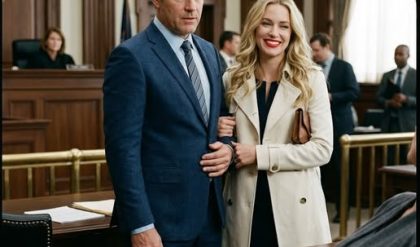
The Echoes of the Altar
The applause faded into a heavy, reverent silence as the final echo of the heavy cathedral doors sealing shut signaled the end of Grant Whitmore’s freedom.
The sanctuary, once a stage for a manufactured tragedy, now felt like a room freshly cleared of suffocating smoke.
Sloane Mercer stood frozen near the front pew, abandoned by the man she had sacrificed her morality for, and surrounded by federal agents who were already gesturing for her to follow them.
She looked at me, her eyes pleading for a mercy she had never shown me when I was a captive in my own home.
I didn’t look back.
I turned my back on her, focusing entirely on the slow, rhythmic breathing of my unborn son.
“Let’s get you out of here, Evelyn,” Henry whispered, his arm firmly supporting my weight as my adrenaline began to crash.
We didn’t leave through the back door like secreTS. We walked out the main entrance of St.
Mark’s Cathedral, down the grand stone steps where dozens of journalists and flashing cameras had already gathered, tipped off by the sudden deployment of federal authorities.
For years, Grant had used the press to build his pristine reputation.
Today, the media would dismantle it.
Four weeks later, the Nashville winter gave way to a crisp, biting spring.
I sat in the glass-walled conference room of Ashford National Insurance Group, looking out over the city skyline.
Across the mahogany table sat Mr. Calloway and a team of prosecutors.
Beside me sat Henry, a constant, unyielding anchor.
“The grand jury has handed down a multi-count indictment,” the lead prosecutor announced, sliding a thick folder toward us.
“Attempted first-degree murder, wire fraud, conspiracy, and insurance fraud.
Because Grant used interstate communications to coordinate the insurance payout and hide assets with Miss Mercer, the federal government is handling the bulk of the prosecution.
He is being held without bail.”
I opened the folder.
Seeing Grant’s mugshot—his hair disheveled, the practiced charm entirely wiped from his face—didn’t bring me joy.
It brought me a profound sense of relief.
“What about the assets?” I asked, my voice steady.
“Frozen,” Mr. Calloway replied, a small, satisfied smile touching his lips.
“Every account he tried to drain from your family’s estate has been secured.
Furthermore, Sloane Mercer has turned state’s evidence.
She provided the encryption keys to Grant’s private digital vault in exchange for a plea deal.
Inside, we found the search histories, the geolocation data from the night you were pushed, and a signed contract with a offshore entity to liquidate your assets the moment the death certificate was finalized.”
They had mapped out my death like a corporate acquisition.
“There’s one more thing, Evelyn,” the prosecutor added gently.
“Grant’s defense attorney tried to submit a motion claiming mental incompetence due to financial stress.
They wanted to place him in a private medical facility instead of a federal penitentiary.”
I looked at Henry, whose gray eyes hardened instantly.
“We anticipated that,” Henry said, his voice carrying the immense weight of his billionaire status.
“Ashford National has retained the top forensic psychiatrists in the country.
Grant Whitmore is not incompetent.
He is a sociopath who made a calculated bet on his wife’s life.
He will stand trial in a court of law, and he will look his victim in the eye.”
 The Inheritance of Silence
The trial took place three months later.
I walked into the courtroom wearing a tailored navy dress, no longer hiding the faint silver scars along my jawline.
They were not marks of shame; they were proof that the river could not claim me.
When I took the stand, I didn’t cry.
I looked directly at Grant, who sat at the defense table in a drab orange jumpsuit, stripped of his expensive suits and custom cufflinks.
I detailed every hidden bruise, every gaslighting conversation, and finally, the terrifying sensation of his hands pushing against my shoulders at the frozen overlook.
When the recording was played for the jury, the defense crumbled completely.
The deliberation took less than two hours.
Guilty on all counTS.
As the judge handed down a sentence of life without the possibility of parole, Grant finally lost his composure.
He lunged against his restraints, screaming profanities at me, blaming me for ruining his life.
The bailiffs slammed him against the table and dragged him out of the courtroom.
I watched him go, feeling absolutely nothing.
The man who had haunted my youth was finally reduced to noise.
Two weeks after the verdict, in a quiet, sunlit room at Nashville General Hospital, my son was born.
He arrived into the world with a fierce, powerful cry, his tiny fists flailing against the warm air.
When the nurse placed him on my chest, I looked down into his clear, bright eyes and felt a warmth that entirely erased the lingering chill of the river.
Henry stood by the bedside, tears blurring his eyes as he looked at his grandson.
“What’s his name, Evelyn?” he whispered.
I brushed a soft patch of dark hair from my baby’s forehead, my heart overflowing with a peace I hadn’t known in a decade.
“His name is Leo,” I said softly, watching him lift his chin, safe and loved beyond measure.
“It means lion.
Because he fought through the dark with me, and we survived.”
The End